
Automated patient outreach uses software to contact patients proactively, at the right moment, without a staff member placing each call or sending each message by hand. This guide covers what it is, where it pays off (patient recall, care gap closure, reminders, intake, and surveys), what to look for in patient engagement software, and how healthcare providers roll it out in a practice or health system.
What automated patient outreach is (and what it isn’t)
Automated patient outreach is any system that initiates patient communication on a schedule or in response to a trigger. A patient is due for a routine checkup, so the system sends a recall message. An appointment is 48 hours away, so the system sends a reminder. A slot opens on tomorrow’s schedule, so the system offers it to patients on the waitlist. In each case the organization defines the rule once and the software carries it out across the whole patient population.
The goal is to reduce manual staff intervention in routine patient communication while keeping people in the process. The front desk handles the calls that need judgment and the automated system handles the volume.
It helps to separate three things that often get lumped together:
- Reminder systems send one-way notifications about upcoming appointments. Automated reminders are the oldest form of outreach and still the most common.
- Patient engagement software adds two-way communication, patient intake, surveys, and recall campaigns to reminders, usually across text, email, phone calls, and a portal.
- AI powered outreach agents can hold an actual conversation. When a patient replies to a recall message asking for a Tuesday afternoon, the agent checks availability, books the slot, and confirms it.
Two-way messaging is the dividing line between the three. A reminder a patient cannot answer creates a phone call for the front desk, while a message a patient can answer closes the loop on its own.
Why healthcare providers are automating outreach
Healthcare providers automate outreach because the administrative tasks involved in reaching patients, confirming visits, and chasing overdue care are repetitive, high-volume, and easy to let slide when the phones are busy. Every message that goes out by hand competes with the patient standing at the desk.
Three pressures have pushed automation from a convenience to a standard part of operations in today’s healthcare landscape:
Patient expectations have changed. Patients book flights, order groceries, and manage banking from their phones, and they expect the same from their healthcare journey. Online scheduling, text confirmations, and digital check-in are now baseline expectations, and the patient experience suffers when a healthcare practice lacks them. In Experian Health’s 2024 State of Patient Access survey, 89% of patients said being able to schedule appointments anytime through online or mobile tools is important to them.
Staffing is tight. Front-desk and call-center turnover leaves fewer people handling more patient interactions. Automation absorbs the routine work so the people who remain can spend their time on the exceptions.
Value-based contracts reward closed gaps. When reimbursement depends on preventive screenings, chronic condition management, and annual wellness visits, the organization has a direct financial reason to reach every eligible patient, including the ones who never call in.
Automated outreach also reduces operational costs by cutting the hours spent on outbound calling, and it improves revenue by filling appointment cancellations and reducing missed services that would otherwise go unbilled.
The core use cases for automated outreach
Most organizations start with reminders and expand from there. These are the five use cases that deliver the bulk of the value.
Patient recall for routine checkups and overdue care
Patient recall is the practice of identifying patients who are overdue for care and bringing them back in. That includes annual physicals, routine checkups, follow-up visits after a procedure, and recurring services like eye exams or dental cleanings. With automated patient recall, the system scans patient records on a schedule, finds everyone past their recall interval, and sends recall messages through the patient’s preferred channel.
Done manually, patient recall is the first task to fall off the list. Done automatically, it runs every week whether or not the office is busy, and that consistency is what keeps lapsed patients from drifting away for good. For healthcare providers of every size, automated patient recall is the foundation of patient retention and patient engagement. For a deeper treatment of recall workflows and cadence, see our guide to patient recall systems.
Care gap closure and managing chronic conditions
Care gap closure extends recall from “who is overdue for a visit” to “who is missing a specific service.” A patient with diabetes who hasn’t had an A1c test in six months, a woman in her fifties who hasn’t been scheduled for a mammogram, a Medicare patient who hasn’t had an annual wellness visit this year: each is a gap the organization is often measured on.
Automated outreach allows healthcare providers to target specific patient populations for preventive care and chronic disease management, then send tailored messages explaining what is due and offering a time to come in. The evidence that outreach moves these numbers is solid. In a 2023 cluster randomized trial published in JAMA across 44 primary care practices, EHR reminders to clinicians alone did nothing for patients with overdue abnormal cancer screening results (22.7% completed follow-up within 120 days, against 22.9% with usual care), while adding patient outreach by letter and phone call raised completion to 31.0%. A 2025 randomized trial of patients overdue for colorectal cancer screening found that text reminders lifted completion of a mailed screening kit from 14.6% to 21.2%. Timely follow-ups after the visit help ensure patient adherence to care recommendations. Our care gap closure guide walks through how to build these campaigns.
Reduce missed appointments with reminders and backfill
Appointment reminders are where most organizations begin, and automated appointment reminders remain one of the simplest ways to reduce no shows. Sending timely reminders at a consistent cadence, typically a week out, two days out, and the morning of, gives patients several chances to confirm or reschedule. Even a second reminder measurably helps. A 2022 randomized study at Kaiser Permanente Washington covering more than 125,000 primary care visits at high risk of no-show found that sending two text reminders instead of one reduced no-shows by 7% for primary care visits and 11% for mental health visits. The best systems remind patients through whichever channel they answer and tie each reminder back to appointment scheduling, so a reply of “I need to move it” opens a rebooking rather than a dead end.
When a patient cancels, the open slot is worth nothing unless someone fills it. Automated outreach can offer the opening to patients on a waitlist within minutes, which turns a missed appointment into a kept one. We cover waitlists and same-day rebooking in detail in how to fill cancelled appointments.
Digital patient intake and online scheduling
Outreach does not stop once the appointment is booked. Sending intake forms, insurance verification, and consent documents ahead of the visit shortens check-in and reduces errors in the patient demographic data that flows into the chart. Digital patient intake also gives the front desk a cleaner patient intake process on the day of the visit.
Pairing intake with online scheduling closes the loop. A patient who receives a recall message, books through a self-service link, and completes intake from their phone has had three interactions with the organization and zero with a staff member.
Patient satisfaction surveys and reputation management
Post-visit outreach is the last step in the patient journey and the one most often skipped. Automated patient satisfaction surveys sent within a day of the visit capture feedback while it is fresh, and the same workflow can invite satisfied patients to leave a public review. Reputation management handled this way runs after every visit instead of whenever someone remembers, and the survey data gives the organization a record of where patient care falls short.
How automated outreach can enhance patient engagement
Reminders alone reduce missed appointments. To enhance patient engagement beyond that, outreach has to feel relevant to the individual patient, and a message written for the whole population rarely does.
Personalization and timing
Personalization of outreach messages starts with the basics: the patient’s name, their provider, the specific service that is due, and their preferred channel. Timing matters as much as content, because a recall message that arrives when the patient is due, instead of in a quarterly batch, reads as attentive instead of automated.
Enhancing patient relationships through consistent contact
Patient relationships are built on consistent contact over time, and that is the hardest thing for a busy office to maintain by hand. Digital tools make it possible to stay in touch between visits without adding headcount, which matters most for patient recall, where the patient has no appointment on the books to prompt a conversation. An automated system that reaches out at every stage of the care journey, from scheduling through follow-up, keeps the organization present in the patient’s health without adding to staff workload. Over years, that consistency produces enduring relationships, and those relationships are what patient retention and practice growth depend on.
Better health outcomes through adherence
The clinical case for automation rests on adherence. Patients who receive screening reminders are more likely to be screened, and patients who receive follow-up messages about managing chronic conditions are more likely to refill prescriptions and keep follow-up visits. Routine patient engagement of this kind is linked to improved health outcomes. A 2020 AHRQ technical brief covering 134 systematic reviews on patient engagement strategies found that the most common clinical outcomes studied were adherence to medication and self-care plans and measures of chronic disease control such as A1c and blood pressure, that most reviews of self-management support reported positive or potential benefits, and that none reported harm. Those are the patient outcomes that value-based contracts measure.
Patient engagement software: key features to look for
Choosing the right patient engagement software comes down to a short list of key features. There is no single best patient engagement software for every setting; a solo practice and a regional health system will weight these differently. These are the questions to ask.
EHR and practice management integration. Effective automated outreach integrates with the Electronic Health Record so it can read patient records, identify who is due, and write confirmations back. Seamless data flow between the outreach tool and existing systems is what separates a working program from a spreadsheet exercise. Ask how the integration handles your EHR and practice management software, since “we integrate” can mean anything from a nightly file export to a live two-way connection.
Two-way communication. Patients must be able to reply, reschedule, and ask questions without being routed to a phone queue. Two-way messaging capabilities are what make outreach communication effective instead of merely frequent.
Personalization at scale. The system should pull patient demographic details, provider, service, and preferred channel into every message without a staff member editing templates.
HIPAA compliance and protected health information handling. Any system that sends messages containing protected health information needs a business associate agreement, encrypted channels, and controls over what detail appears in a text or voicemail. HIPAA compliance is a crucial element of vendor evaluation and deserves more scrutiny than a checkbox.
Reporting. You should be able to see delivery rates, response rates, bookings generated, and gaps closed by campaign.
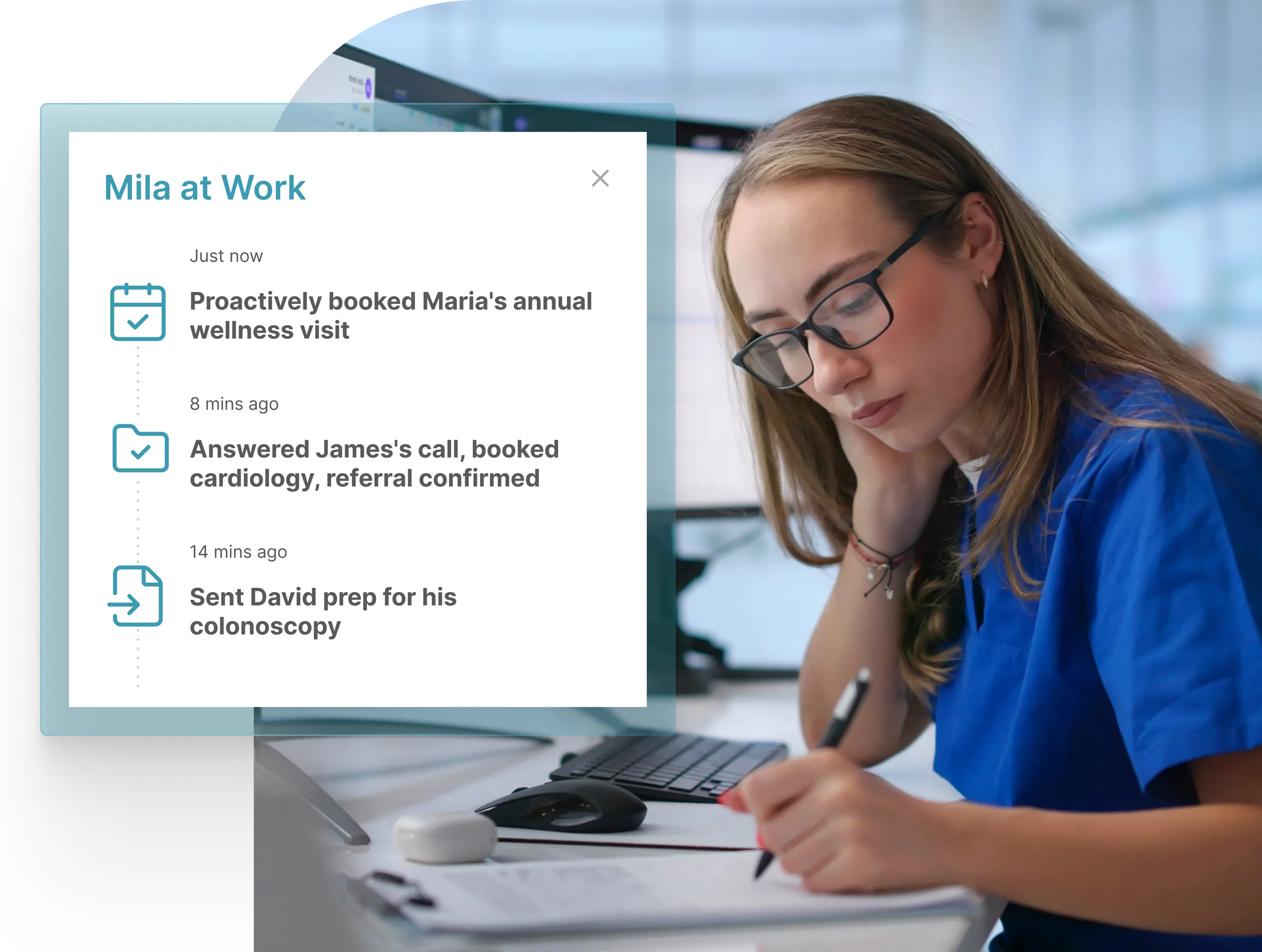
meet mila
DexCare knows.
Mila Talks.
An AI care coordinator built on your data, guiding patients from first outreach to follow-up without adding headcount.
Patient interactions across communication channels
Patients differ in how they want to be reached. Some answer texts within minutes while others only pick up phone calls or check a portal. The software should support multiple communication channels, let patients set their preference, and fall back from one channel to the next when the first draws no response. Communication tools that only support a single channel leave part of the patient population unreached.
Innovative technology: AI agents versus rules-based reminder systems
The most recent shift in patient communication is the move from rules-based automation to conversational AI. Rules-based systems send a message when a condition is met. AI agents can also handle what comes back. When a patient replies “can I do Thursday instead,” a rules-based system creates a task for the front desk. An AI agent checks the schedule, offers Thursday’s openings, books one, and sends the confirmation.
The same shift is reaching patient scheduling, intake, and after-hours phone coverage, but outreach is where the difference between automated systems that notify and AI agents that converse shows up first. Because the AI agent handles each reply without staff time, the organization can afford to reach every overdue patient instead of only the highest-priority ones, and outreach can run outside business hours, when many patients are free to respond. Judge any innovative solution of this kind on one thing, how often it resolves a conversation without human help.
Implementing automated outreach in a practice or health system
A rollout that works in a three-provider office follows the same shape as one in a multi-hospital health system. The scale differs and the sequence stays the same.
- Define the patient population and the trigger. Start with one use case and one clear rule. Patient recall is the usual first campaign because the trigger is simple and the payoff is immediate. “Every patient without a visit in 14 months receives a recall message” is a good first campaign. “Engage patients more” is not.
- Confirm the data is clean. Recall and care gap campaigns are only as accurate as the patient records behind them. Audit contact details and recall intervals before the first send.
- Integrate before you launch. Connect the outreach tool to the EHR and scheduling system so bookings write back automatically. A campaign that generates replies no one can act on creates more work than it removes.
- Set the cadence and channel rules. Decide how many attempts, how far apart, and in what order of channels. Build in an easy way for patients to opt out.
- Train the team on exceptions. Staff should know what the system handles and what lands in their queue, so they are not duplicating messages or ignoring escalations.
- Launch narrow, then expand. Run the first campaign for a month, review the results, and only then add care gap closure, intake, or surveys.
These steps apply across healthcare settings, from medical practices and dental practices to specialty groups and hospital-based clinics. In larger healthcare organizations, the main addition is governance: who owns message templates, who approves new campaigns, and how outreach is coordinated across departments so patients are not contacted by three service lines in the same week.
Measuring enhanced patient outcomes and practice growth
Ongoing monitoring of performance metrics is essential for optimizing automated outreach strategies. The metrics worth tracking fall into three groups.
Operational metrics tell you whether the system is working: messages delivered, response rate by channel, conversations resolved without staff involvement, and staff hours saved on outbound calling. These show the effect on administrative burdens and operational efficiency.
Access metrics tell you whether patients are getting in: recall appointments booked, care gaps closed, cancelled slots refilled, and no-show rate by campaign. These are the numbers that connect outreach to revenue.
Experience metrics tell you whether patients notice: patient satisfaction scores, survey completion rates, review volume and rating, and patient retention year over year. Enhanced patient satisfaction shows up later than the operational gains, so give the program time before judging it on experience alone.
Review these monthly for the first quarter and quarterly after that. The campaign-level results will show which one or two use cases produce most of the return, which is the information you need when deciding where to expand next.
Mila: DexCare’s AI agent for automated patient outreach
Mila, DexCare’s AI agent, handles patient outreach as a conversation instead of a notification. It runs recall, care gap, reminder, and backfill journeys across voice and text, responds to patients when they reply, books into the schedule, and keeps the context of every interaction so patients never have to repeat themselves. It works for independent practices and health systems alike and connects to the systems in place.
Learn more about Mila or request a demo to see how automated outreach runs when the agent can finish the conversation.