Care gap closure is the work of finding patients who are due for a screening, a wellness visit, a follow-up, or a referral, contacting them, and bringing them back in. Health plans and federal programs score your practice or health system each calendar year on the share of eligible patients who received that care, and those scores decide incentive payments, bonus payments, and grant funding. Most organizations know which gaps are open. Whether the score improves usually depends on whether anyone on staff had the time to reach the patients on the list before the year closed.
What a care gap is, and why open gaps accumulate
A care gap is the distance between the care a patient should have received under an evidence-based guideline and the care your records show. Open gaps include overdue cancer screenings, missed annual wellness visits, unfilled referrals, lapsed chronic condition monitoring, and treatment plans with no follow-up visit on the calendar.
Gaps accumulate for ordinary reasons. A patient leaves a visit without the next appointment on the calendar, a referral is placed and never scheduled, a mammogram order expires, or the patient changes phone numbers and no medical record flags the lapse. Events like these trigger no alert on their own, so the gap stays open until someone on your team runs a care gap report from the EHR and starts calling.
Your EHR, or population health software that reads from it, can identify most open gaps by comparing each patient’s billing claims and clinical data against the guideline. The slow steps come after identification, when staff contact each patient, schedule the visit, and confirm it was completed. The hours available for that outreach, more than the analytics behind the list, decide how many gaps close and how much patient outcomes improve.
The quality programs that score care gap closure
Three programs turn open gaps into dollars, and each one scores a similar handful of preventive and chronic care measures. A measure is the percentage of eligible patients who received a specific service in the calendar year, which the programs call the measurement year.
HEDIS. The Healthcare Effectiveness Data and Information Set is the measure set maintained by the National Committee for Quality Assurance (NCQA) and used by more than 90 percent of U.S. health plans. HEDIS measures include breast, cervical, and colorectal cancer screening, diabetes management, blood pressure control, and dozens of others. Plans are judged on their HEDIS results, so the value-based contracts plans hold with providers often pay incentive dollars on the same measures. Plans calculate most of these measures from billing claims, which is why a completed screening only counts once the claim for it has been filed.
CMS Star Ratings. The Centers for Medicare & Medicaid Services (CMS) rates every Medicare Advantage plan from one to five stars, and plans at four stars or above receive quality bonus payments. Plans with prescription drug coverage are rated on up to 43 quality and performance measures, many of them HEDIS measures. A plan that pays a bonus to a practice for closing gaps is spending part of the bonus it expects from CMS.
UDS. Community health centers and clinics funded by the Health Resources and Services Administration (HRSA) report their clinical quality results to HRSA every year through the Uniform Data System, as a condition of the grant. Key UDS measures include cervical cancer screening, breast cancer screening, colorectal cancer screening, and depression screening with follow-up. In 2024, health centers nationally screened 55 percent of eligible patients for cervical cancer, 54 percent for breast cancer, and 43 percent for colorectal cancer. The federal Healthy People 2030 targets for those measures are 84.3, 80.5, and 74.4 percent.
Because every measure divides patients who received the service by all patients who were eligible for it, patients you have not seen in 18 months count against you just as much as the ones in the waiting room. Reaching those absent patients is where higher rates come from.
Annual wellness visit outreach, step by step
The Medicare Annual Wellness Visit is covered under Part B with no cost sharing, and patients are eligible for one every 12 months after their first year of Part B coverage. During the visit, a physician, nurse practitioner, physician assistant, or one of several other qualified health professionals reviews medications, screens for cognitive and functional problems, and creates or updates a personalized prevention plan. Because the AWV is the visit where many other gaps are found and the orders for them written, it anchors most gap closure programs.
Most eligible patients still skip it. Physicians billed Medicare for 7.8 million AWVs in 2020 and 8.6 million in 2022, according to an analysis of 100 percent Medicare physician claims published in the Journal of the American Board of Family Medicine, while CMS counts about 34 million people with Original Medicare who used Part B services in 2022. The gap between those two numbers is the outreach opportunity.
A working AWV outreach process has four parts.
1. Build the eligible list from EHR data. Pull every Medicare patient who has not had an AWV in the past 12 months. Then rank the list by the number and severity of each patient’s other open gaps, a step often called risk stratification, so a patient overdue for colorectal screening and a diabetic eye evaluation is contacted before one with no other gaps.
2. Reach out in the patient’s preferred channel. Multi-channel outreach includes SMS, voice calls, email, and portal messages. Build awareness in the first message by naming the visit and stating that Medicare covers it in full, then offer a specific appointment slot. A personalized message of that kind performs better than a generic reminder to call the office.
3. Schedule in the same conversation. Patients drop off at every handoff between the outreach message and the booking. If the message cannot book directly, route the patient to a person or system that can confirm the appointment in real time.
4. Confirm and remind. Automated appointment reminders can reduce no-show rates. Send a confirmation in whatever form the patient chose at booking, then reminders in the days before the visit with a one-tap option to reschedule. Medicare has reimbursed AWVs delivered by telehealth since March 2020, which removes the trip for patients who cannot travel, and offering that option in the reminder can raise completion.
Referral management that closes the loop
An unscheduled referral is one of the hardest open gaps to see, because the referral was placed and the chart looks complete. A referral loop closes when the specialist visit is completed and the results return to the referring provider.
Referral management for gap closure follows the same pattern as AWV outreach. Identify referrals that have gone longer than a threshold you set, 14 days for example, with no scheduled appointment, including referrals to specialists outside your organization whose scheduling processes you cannot see. Contact the patient, discuss any barriers, and help them schedule. Confirm attendance, and if the visit did not happen, restart the sequence. Patient safety improves when nobody falls between the referring office and the specialist.
Preventive services outreach for community health centers
Community health centers face this gap closure problem with fewer resources and a patient population that is harder to reach. Phone numbers change more often, work hours are irregular, and about one in four health center patients was best served in a language other than English in 2023, according to UDS data.
Three adjustments help a center reach more of those patients. Outreach timing that includes evenings and weekends reaches patients who cannot take a call during clinic hours. Bundled scheduling lets a single outreach contact book the cervical cancer screening, the depression screening, and the blood pressure check together instead of through three separate calls. Language is the third adjustment.
Multilingual support in every channel
Messages written in the patient’s language reach more patients than messages translated by the front desk on the fly, and voice calls and text replies follow the same rule. A patient who answers a text in Spanish should receive the scheduling follow-up in Spanish, without a transfer to a bilingual staff member the center may not have on shift.
Center leaders who track each UDS measure separately can see which gaps close once the patient is contacted and which stay open even after the patient is in the room. The second kind is an in-clinic workflow problem, and more outreach will not fix it.
Patient outreach that closes gaps and protects patient satisfaction
Outreach that is clumsy or repetitive costs you goodwill. The same patient should not receive a text, a call, and a letter about the same mammogram in one week. Putting every open gap for a patient into one conversation, setting contact limits per channel and per month, making it easy to opt out of a channel without opting out of care, and using plain language in every communication all keep outreach welcome.
Natural language processing and patient replies
When a conversational system handles outreach, make sure its natural language processing can handle an answer like “I already had that done at another clinic” by logging the reply, pausing further reminders, and flagging the chart so staff can request the outside record, instead of sending the next reminder.
How to evaluate whether gap closure is working
Measure the program the way the quality programs will measure you. For each measure, track the eligible patients, the number contacted, scheduled, and completed, and the percentage closed, and report those numbers monthly rather than at year end.
Walk the numbers back to staff hours as well. The cost of a manual gap closure program is mostly the time your team spends dialing, and a program that closes gaps precisely but only for the first 300 patients on a 3,000-patient list has a staffing problem rather than a design problem.
Automated patient outreach and DexCare’s AI agent
Automated patient outreach contacts hundreds of patients simultaneously across SMS, voice, and email, books the appointment in the same conversation, and sends the confirmation, which cuts the manual outreach time your staff spend on each gap. The integrated systems that do this well read the open gap list from your EHR, keep the context of every conversation with a patient, and hand off to a person when a patient needs one.
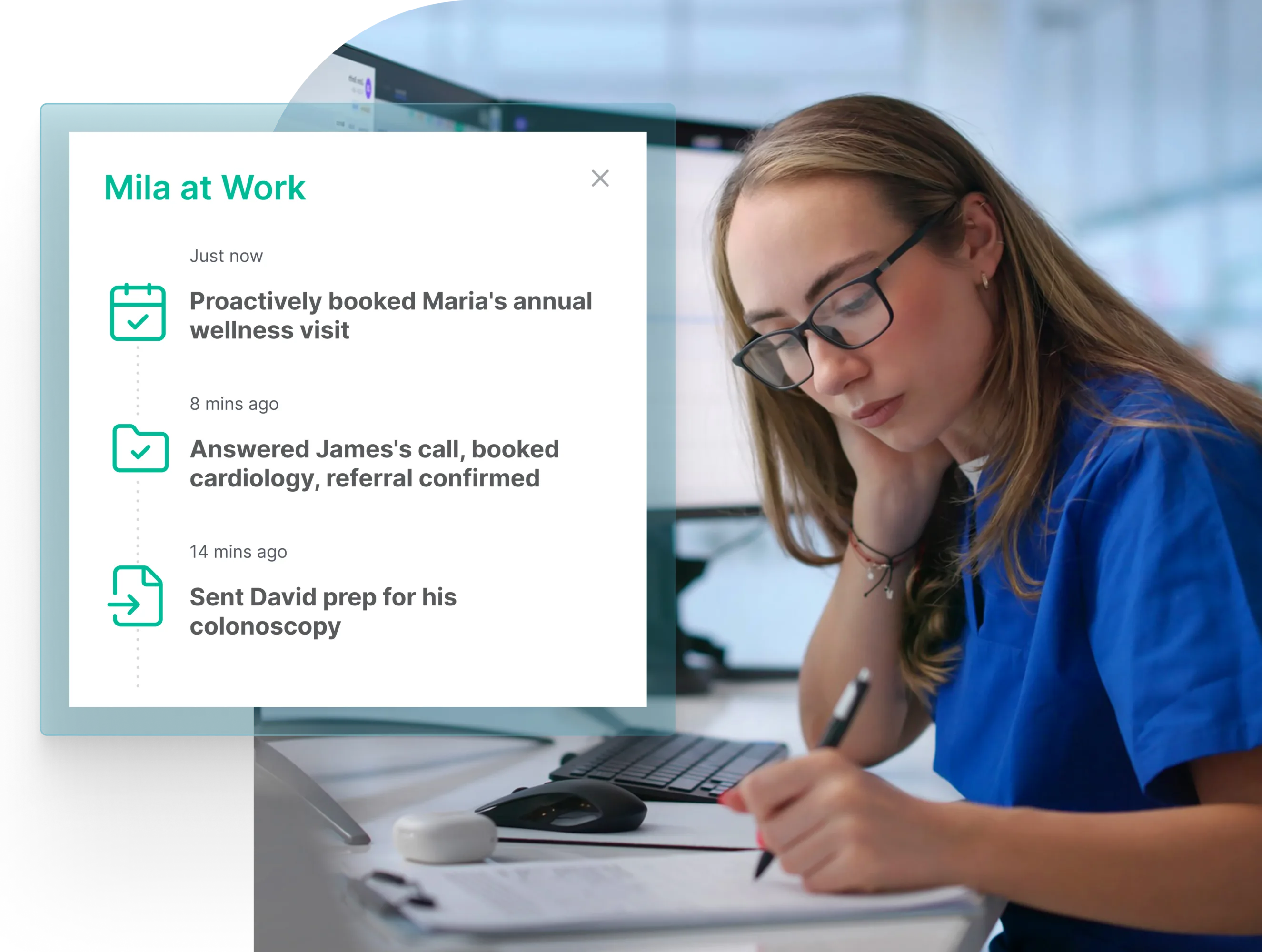
Mila, DexCare’s AI agent, runs outreach for care gap closure, annual wellness visit scheduling, and referral follow-up as end-to-end patient journeys, keeping the context of every inbound and outbound conversation. Learn more about Mila or request a demo to see how Mila works alongside your current scheduling workflow.
Related reading: Patient recall systems: how to bring lapsed patients back and How to fill cancelled appointments.
meet mila
DexCare knows.
Mila Talks.
An AI care coordinator built on your data, guiding patients from first outreach to follow-up without adding headcount.