
You’re running a large group practice, and your patient recall list keeps growing.
One patient is six months overdue for an annual wellness visit. Another was supposed to schedule a follow-up colonoscopy three months ago. A third was asked to return in four weeks but never booked the appointment.
These patients haven’t necessarily left your practice. They may simply need a reminder and an effortless way to book the visit. But who’s doing the outreach? Without a consistent process for turning overdue care into booked appointments, recall lists get longer, overdue care remains unscheduled, and your practice misses its most direct path to growth.
What Recall Lists Look Like in a Busy Practice
The definition of “overdue” varies by specialty. Primary care practices and accountable care organizations (ACOs) need to remind patients of their overdue hemoglobin A1c checks, mammograms, and well visits. GI practices need to reach out to patients overdue for colonoscopies. And in orthopedic, cardiology, and dermatology practices, unfinished follow-up visits and post-event encounters sit at the top of the list.
No matter the reason, recall lists spiral out of control fast. Picture a three-physician practice with 4,500 patients, 1,200 of them overdue for an annual preventive visit. If even 20% of those patients booked, that’s 240 additional visits, not including the screenings, labs, and referrals that follow.
Direct Outreach Encourages Patients to Complete Overdue Care
When practice staff reaches out to patients proactively, patients are more likely to complete their prescribed follow-up care.
In a randomized clinical trial published in JAMA, researchers followed nearly 12,000 patients across 44 primary care practices overdue for follow-up after an abnormal breast, cervical, colorectal, or lung cancer screening. Adding a reminder to the EHR made little difference. Only 23% of those patients completed a follow-up within 120 days, nearly the same as with traditional follow-up. But when patients also received a letter and a phone call, completion rose to 31%.
But Staff-Only Outreach Is Hard to Scale
Asking practice staff to follow up with patients directly isn’t always feasible. Your schedulers already have a steady stream of incoming calls, appointment requests, cancellations, and referrals to manage. Those tasks demand immediate attention. Patient recalls, meanwhile, require someone to review a list, identify who needs follow-up, contact each patient and help them find an appointment. It’s time-consuming work that often gets pushed to the back burner.
Staffing a busy practice is also a challenge. About four in five medical practice leaders surveyed by the Medical Group Management Association in November 2026 reported an open administrative position. Among openings of one to three months, nearly half involved reception, scheduling, or phone work.
meet mila
DexCare knows.
Mila Talks.
An AI care coordinator built on your data, guiding patients from first outreach to follow-up without adding headcount.
Routine office hours present yet another barrier. Most practices only make calls between 9 a.m. to 5 p.m., when most patients are at work. By the time patients hear the message and call back, the office is closed, creating a frustrating game of phone tag.
Automate Follow-Up With an AI Agent
AI agents can help busy medical practices connect with lapsed patients and work their recall list. But not all AI agents are alike. Some can only answer basic questions. Others can only handle inbound calls.
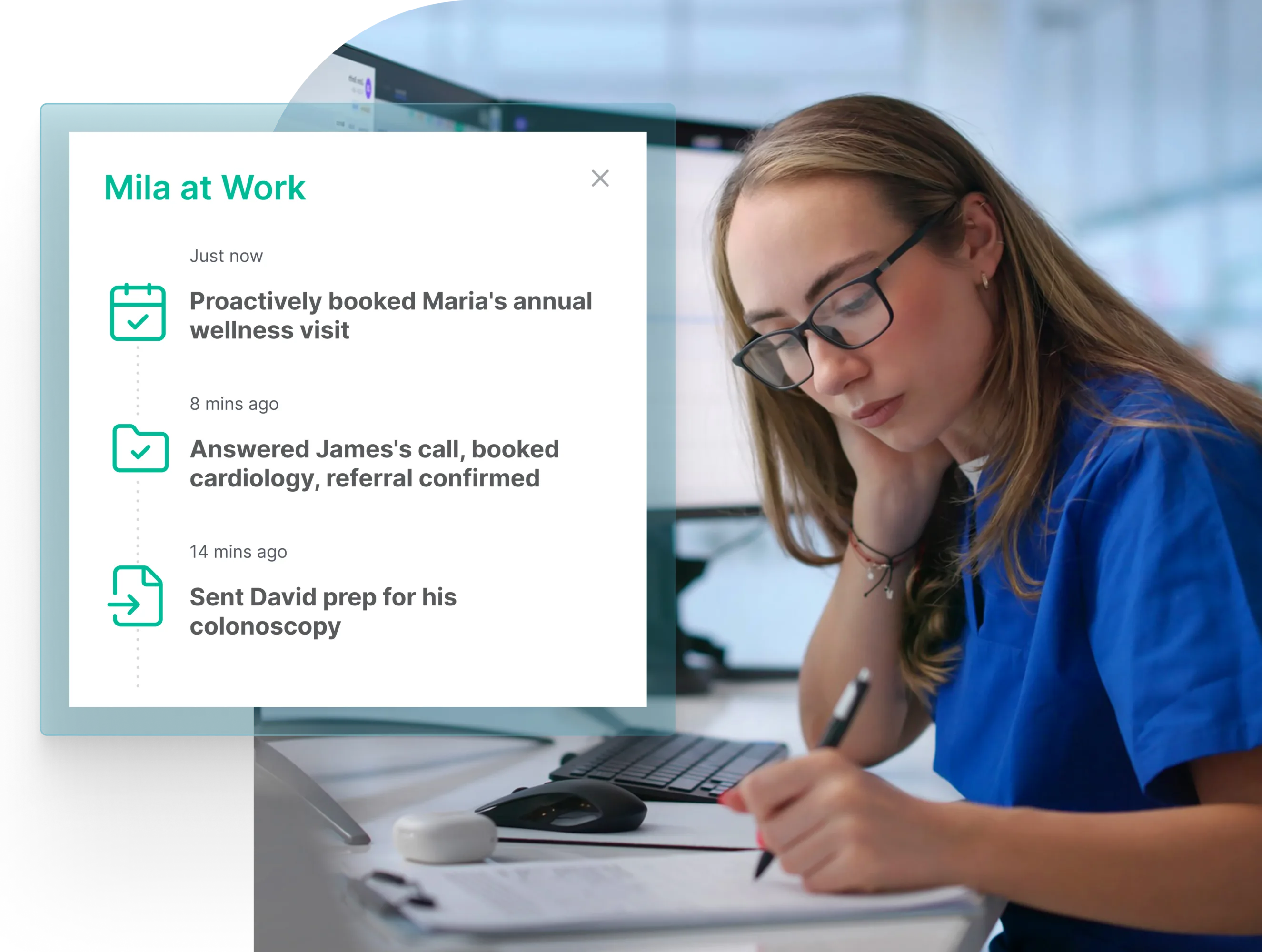
Mila, DexCare’s AI scheduling agent, is different. Mila combs through the EHR, identifies patients overdue for care and reaches out to them by text and voice, including on evenings and weekends. She explains why the visit is important, finds an open appointment that fits the patient’s schedule and the practice’s booking rules, and books the visit.
In the days and weeks between scheduling and appointment, Mila performs additional outbound outreach. For someone overdue for a colonoscopy, Mila confirms the procedure appointment and sends bowel prep instructions in advance, so the patient is ready for their exam. After the colonoscopy, Mila can also reach out and schedule any necessary follow-up visits.
Mila is proven in medical practice settings. At Aayu Clinics, a multi-specialty medical practice in Chicago, Mila “increased appointments and adherence by 25% and saved 10 hours a week on outreach,” says Dr. Abhijit Shinde, MD, the practice’s founder and CEO.
How to Size Your Recall List
Unsure how large your recall list might be? Here’s a five-step process you can perform in one afternoon to find out.
- Run reports in your EHR to find overdue patients by visit type.
- Clean the list. Remove patients who have already been scheduled, have moved, transferred care, or have been discharged from the practice.
- Segment by length of lapse. Group patients at 0–6 months, 6–12 months, and 12+ months past due. Recently lapsed patients tend to book more readily.
- Apply a booking rate. Use your own past recall numbers if you have them. If not, make a conservative estimate and adjust once you have real numbers.
- Attach revenue. Use your average reimbursement for that visit type, plus the downstream services it creates, to estimate your potential revenue gain.
Once you’ve properly scoped your recall list, take action to tackle it.
Want to hear and see how Mila works with patients?
Want to see how Mila could help? Book a 30-minute walkthrough today.