

Patient Scheduling Software
The control center
for patient access.
Patient access control center.
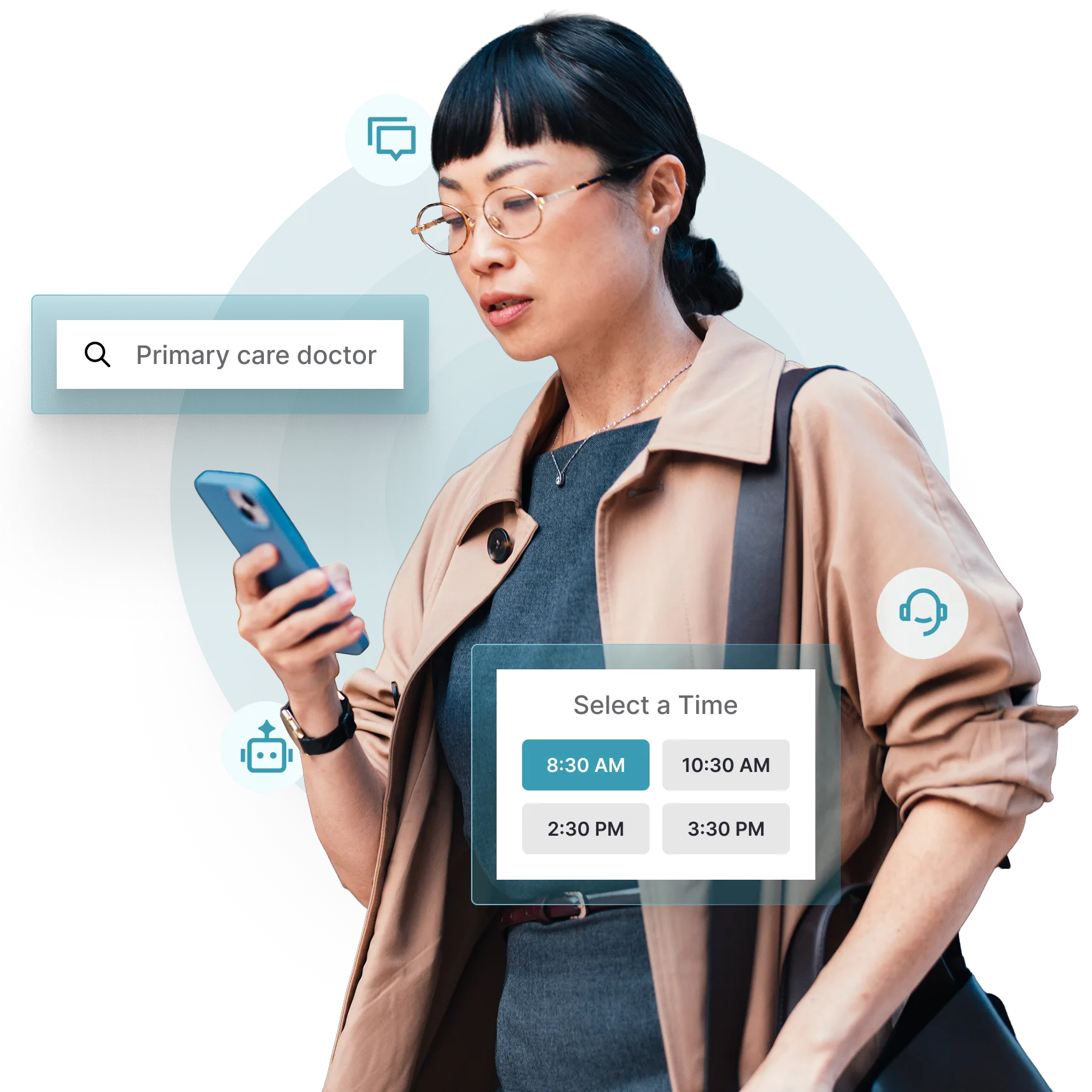
One platform for flexible scheduling across patient access touchpoints. Enter your site and we’ll build you a live demo. See it work first before talking to sales.
One platform, every touchpoint. Enter your site, get a live demo, see it work first.
Secure sandbox
Your providers
No setup on your end
Not sure? See what to expect.
Your URL
2
Your Details
3
Demo Ready
Where should we send your demo?
Add your details and we’ll build your environment, then email a private link to launch it.
Demo in Review
We’re putting the finishing touches on your demo.
Our team is reviewing your environment to make sure your providers, specialties and locations look just right. you’ll get a private link by email — usually within one business day.
We’ll send your customized demo to the email provided.
Questions? Just reply to that email.







increase in new patient acquisition
increase in appointments booked online
retail booking conversion rate
many paths, one door
No wrong way in
However patients start, navigation gets them there.
However patients start, one place to book.
A Google search. Your homepage search bar. Or a symptom typed into Find a Doc. Patients come in through dozens of doors. DexCare treats every one as the front door, so no path dead-ends before a booked visit.
Search engines. Your homepage. Find a Doc. An article they clicked. Every door leads to the same system, so no path dead-ends before a booked visit.
ONE ACCESS PLATFORM
Acquisition. Search. Directories. Booking. One system.
Acquire. Search. Direct. Book.
Each capability works on its own. Together they cover the whole path from first search to booked visit.
SEO & AEO
Acquire
Other pages hope Google notices. These pages are built to be the answer.
Be the answer patients find first. Pages built to rank and load instantly.
navigation
Site Search
Other site searches end in a link. Ours ends in an appointment. Add it to any page on your site, and patients immediately know where to start.
Other site searches end in a link. Ours ends in an appointment.
Provider directory
Find a Doc
Not a directory. A router. Provider, specialist, nurse, nearest, wherever the patient needs to land.
Auto-routes patients to the right fit. Provider, specialist, nearest.
VERIFICATION
Smart Scheduling
The booking checks itself. Preferences, availability, rules, verified before the patient hits confirm.
Verified first. Checked against rules before the patient confirms.
one doorway
Land anywhere. Book right there.
Land anywhere. Book right there.
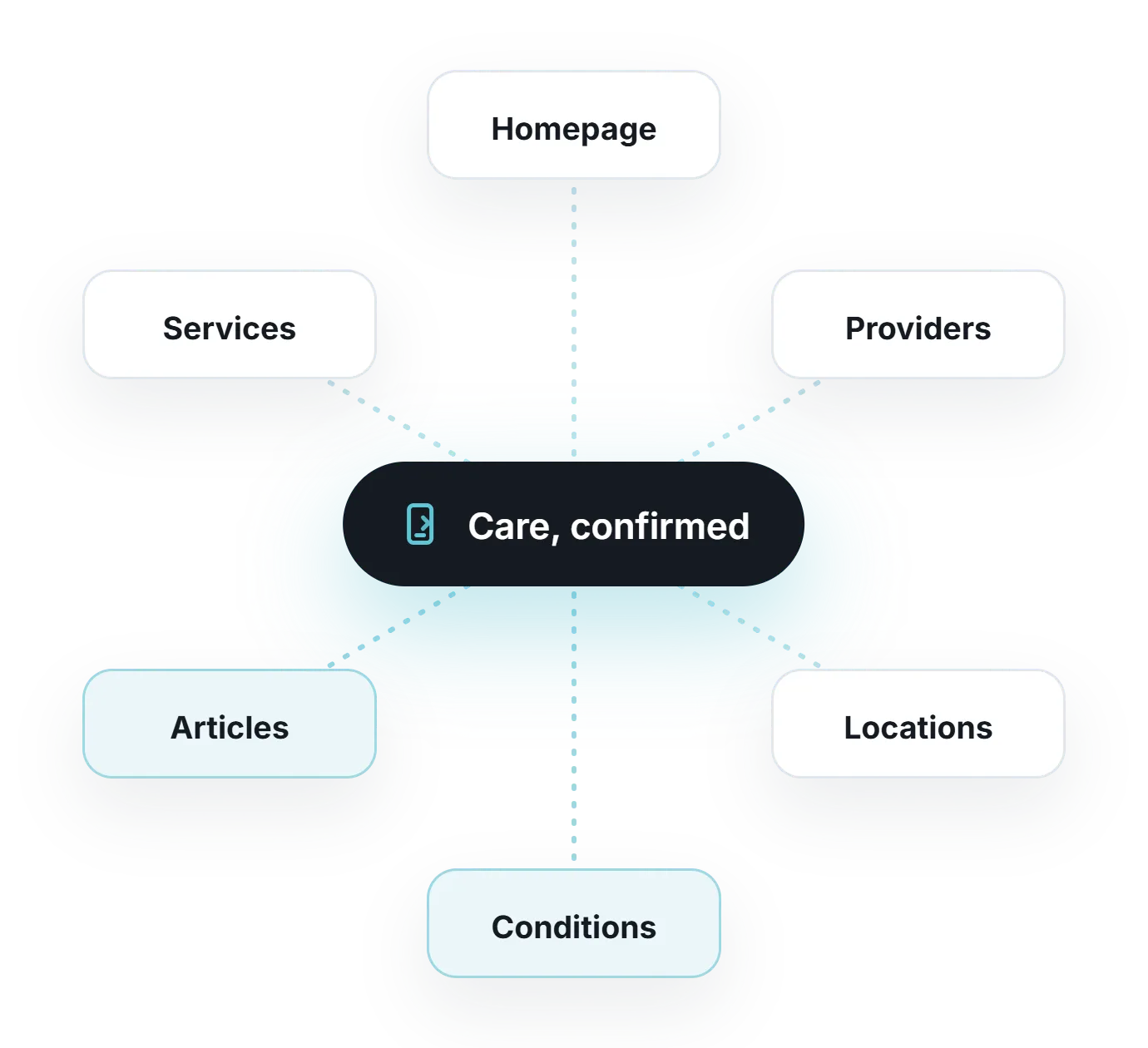
75–80% of visits are organic and direct. Patients discover provider bios, location pages, service lines, condition pages, and articles. Every one of those pages is a doorway to find and select care. We put booking on the pages they land on.
Most visits are organic and direct. Provider bios, location pages, service lines, articles. Every page leads to care.
Content pages like Articles and Conditions can drive as much organic traffic as the homepage. And sometimes more.
The mavericks
Leaders who rebuilt patient access from the ground up.
“Start with the patient experience, don’t begin with technology. Begin with where there’s friction that patients encounter.”
Crystal Broj
Chief Digital Transformation Officer, MUSC
“There’s really nothing out there that compares favorably to DexCare. Giving people real, immediate access … it’s the ballgame.”
Todd Gentzel
Former SVP Strategy, Texas Health Resources
Hear from more customers
Erin Powell — SSM Health Customer Story
Jamie Bishop — University of Rochester Customer Story
Crystal Broj — MUSC Customer Story
Todd Gentzel — Texas Health Resources Customer Story
FAQs
What is patient self-scheduling?
Patient self-scheduling lets patients book, reschedule, or cancel appointments online on their own, without calling the office. The system reads live availability from the EHR, applies the same rules a front-desk scheduler would apply (visit type, provider constraints, new versus returning patient), and writes the confirmed appointment back so staff and patient see one calendar. Health systems use it to give patients a faster path to care while lowering call volume and reducing no-shows.
Why do patients abandon online scheduling?
Patients abandon online scheduling when the booking flow does not reflect current availability. They search, land on a page with scattered options, click through a long decision tree, and reach a slot that turns out to need a phone call to confirm. Many give up and call the contact center, or book with a competitor instead. The cause usually sits upstream in the scheduling logic and provider data feeding the booking tool. When that foundation is fragmented, even a polished front end shows patients incomplete or outdated options.
What is the difference between a digital front door and patient navigation?
A digital front door is the set of patient-facing pages and apps where people find and book care. Patient navigation is the logic underneath that decides which provider, location, and modality fits each patient, then routes them to an option that is appropriate and available. A digital front door can look polished and still send patients to dead ends when the navigation logic behind it is fragmented across locations and systems. The health systems getting access right build the navigation layer first, then connect every front-end channel to it.
How are patients using AI search to find doctors?
Patients increasingly begin care decisions inside AI tools like ChatGPT, Perplexity, and Google’s AI Overviews rather than a directory or a page of blue links. ChatGPT answers health questions from roughly 230 million people each week, AI Overviews have pushed organic click-through rates down from 1.6% to 0.6%, and AI search visitors are 4.4 times more valuable than traditional organic visitors. High-intent local searches such as “orthopedist near me” still rarely trigger an AI Overview, so local SEO and answer engine optimization cover different parts of the funnel. Appearing in both depends on structured, accurate provider data that AI engines can read and cite.
What is DexCare Search & Schedule?
DexCare Search & Schedule connects digital discovery, care navigation, and scheduling into one guided path from an online search to a booked visit. It interprets what a patient needs, matches them to appropriate and available providers, locations, and modalities using the health system’s own rules and capacity signals, and books a live, EHR-backed appointment. The routing logic underneath the pages keeps demand balanced across the system and reduces mis-routed visits. DexCare powers patient access for 57 million patients across all 50 states.
How does DexCare match patients to the right provider and location?
DexCare matches patients using routing logic that reads the health system’s rules, clinical guidelines, and current capacity across every provider and location. A symptom or condition query maps to the appropriate specialty, a location query surfaces nearby clinics with openings, and virtual visits appear when they fit. When a primary location is full, the system promotes a nearby option that has availability. Every channel, from the website and Find a Doc to the contact center and AI agents, draws from the same logic, so a patient gets a consistent answer wherever the journey starts.
Does DexCare integrate with our EHR?
Yes. DexCare shows live appointment slots pulled directly from the EHR rather than static lists, and writes confirmed bookings back to it, so the front desk and the patient work from the same calendar. Scheduling rules that govern appointment types, visit lengths, and provider constraints stay consistent across systems, which keeps online bookings accurate and prevents the follow-up calls that come from double-booked or invalid slots.
What results do health systems see with DexCare Search & Schedule?
Health systems using DexCare report measurable gains in booking and new patient growth. Providence increased new patient acquisition by 30%, holds a 97 net promoter score, and sees $836 in 90-day downstream spend per net-new patient. Texas Health Resources grew appointments booked online by 56%. SSM Health reaches a 79% conversion rate on urgent care bookings and quadrupled online scheduling completion. Piedmont cut patient wait times by five days.
Stop losing patients to closed doors.
Patients get to care faster. Call centers stop fixing bad bookings. Capacity fills where it should.