
When a patient cancels, the slot can still be filled. Whether it is depends on how much notice the patient gives, whether a patient on the waiting list fits the opening, and whether the front desk has a process ready before the call comes in. This article covers how to fill cancelled appointments: a waiting list the front desk can work, backfill rules by service line, same-day rebooking, and the patient communication that reaches patients before the slot expires. The same approach applies to healthcare providers at any scale, from a single-specialty practice to a health system with dozens of locations.
Why last minute cancellations go unfilled
A no show and a cancellation leave the same empty appointment slot, but only the cancellation comes with notice. Cancellations are also far more common. A study of nearly 81,000 outpatient imaging exams at one academic medical center found 21.9% were cancelled and 1.9% were no shows, and patients initiated more than 70% of the cancellations. An outpatient palliative medicine clinic recorded 38% of 8,054 scheduled appointments cancelled and 6% no shows over six months in 2023.
Whether the slot is filled depends on how much notice the patient gives and whether anyone owns the refill. Mayo Clinic Health System found late cancellation openings went unfilled where no one on the care team owned a defined process for them. With two days of notice, an opening can be filled through normal booking. With two hours, it is filled only when that process is in place before the call comes in. MGMA’s 2025 DataDive found that about 27% of cancelled appointments were rebooked within 30 days in 2024, down from roughly 62% the year before, while cancellations rose sharply. MGMA’s benchmark for openings within 48 hours is a fill rate of 85% or better.
Build a waiting list the front desk can work
A waiting list kept as a spreadsheet or a column in the scheduling software fills a slot only if someone opens it within minutes of the cancellation. The Mayo Clinic Health System study found refill methods varied by department, and the authors recommended redesigning the workflow so the waiting list is used to fill late cancellations. Waitlist management starts with ownership. One person or role manages the list, keeps it current and acts on it the day an opening appears.
A waiting list the front desk can work records the same patient information every time:
- Visit type and provider, so the opening is matched to a patient who can use it
- Location and the patient’s availability, including days, hours and how much notice they need
- Preferred channel, text message or phone, and consent to notify the patient when a slot opens
- Date added, so the order is clear and stale entries can be removed
Patients join the waiting list at booking, through the portal or by text, and can leave it the same way. Providing patients with a way to add themselves keeps the list current without front desk time.
Backfill rules that protect the schedule
Offering every opening to the whole waiting list fills slots quickly but puts the wrong patients in some of them. In a June 2026 MGMA article on backfill rules, a neurology and neurosurgery group blocks its automated waitlist tool from filling any opening less than 72 hours away, because a patient booked on short notice arrives without imaging, records or intake complete, and the visit is either cut short or repeated. The same group requires every fill to match the provider’s template, so a follow-up never takes a new-patient slot because the two happen to be the same length.
Rules that fit most service lines:
- Lead-time floors by visit complexity: same-day for routine visits, 24 to 48 hours for visits that need records, 72 hours or more for prep-heavy visits
- Visit-type matching tied to the provider template rather than slot length
- A deny list of slots that never auto-fill on short notice, such as procedures
- Overbooking only in high-volume, low-complexity settings with predictable no shows, since double booking elsewhere creates rework for schedulers and providers
MGMA’s advice is to pilot the rules on one service line and review them quarterly, because a dashboard can show a strong fill rate while providers absorb the cost of mismatched visits.
Same-day rebooking
Same-day rebooking means a cancellation at 8 a.m. becomes a booked visit by 9 a.m. without a scheduler making a dozen calls. Self-service rescheduling does much of the work, because available slots are offered to patients in advance of any call from the front desk. At UCSF Health, an EHR-based tool that automatically offers earlier open slots to patients with a later appointment sent 60,660 offers over about nine months. Patients accepted 6,703 of them and were seen a median of 14 days sooner, which added 2,576 hours of patient service capacity. The authors estimated about $3 million in physician professional fees for those visits, and noted that not all of it was net new revenue.
Moving a patient earlier opens a later slot, and a later slot comes with more notice, so the same cancellation is easier to fill on the second pass. A patient seen two weeks sooner and a provider calendar with fewer gaps are the two better outcomes the tool is measured on.
Patient communication that fills the slot in time
An offer fills the slot only if the patient reads it before the slot expires, so the channel the front desk uses comes first. A Sinch Engage survey of 1,000 U.S. patients in December 2025 found 90% prefer to receive healthcare communication by text, ahead of email (59%), patient portals (55%) and phone calls (34%). A text message can be read and answered in a matter of minutes from a waiting room or a parking lot; a voicemail may not be heard until evening. Phone calls still fit patients who have asked to communicate that way and complex visits where a scheduler needs to confirm that prep is complete.
Automated waitlist outreach sends the offer to eligible patients in order, gives each a short window to confirm, and moves to the next if there is no reply. The schedule updates when a patient accepts, and the front desk sees the result without making a call, which is what makes automated outreach more efficient than a call list. When nobody accepts, the team knows early enough to try another route, such as offering the slot to patients with an upcoming visit of the same type or to patients overdue for a screening, the same outreach covered in care gap closure for practices and health systems.
Some last minute cancellations can be prevented at booking. A cancellation policy stated at booking and repeated in automated reminders, with a reschedule option inside the reminder itself, gives patients a way to free the slot days in advance rather than hours ahead. The same message can carry directions, prep instructions and a number to call for support.
Reduce no shows so there is less to fill
Reminders are the least expensive way to reduce no shows, because a patient who cancels in reply to a reminder frees a slot that can be filled. Automated reminders need the date, time, location and provider, and a reply option to confirm, cancel or reschedule. Epic Research’s analysis of more than 1.6 billion face-to-face outpatient visits in 2024 found patients with an active patient portal had a no show rate of 6.2%, compared with 7.9% for patients without one, a difference the authors associate with 21 million fewer missed appointments. A portal gives patients access to their appointment details and a way to cancel from a phone. How appointments are offered affects no shows as well. A 2024 systematic review found 10 of 16 studies showed a significant drop in no shows under open access scheduling, where patients book close to the day they call.
Tracking cancellation and no show data by provider, visit type and day of week shows which providers, visit types and days lose the most slots and which strategies to implement first. A patient who has missed twice may need a different reminder cadence, a different channel or a different appointment time rather than a third identical message, and a patient who has stopped booking altogether belongs in a patient recall system rather than the reminder queue.
What to look for in appointment waitlist software and no show management software
Scheduling software vendors describe these features in different ways, and many solutions sold to healthcare providers bundle them with reminders and intake. For your practice or health system, the capabilities that fill cancelled appointments:
- A waitlist tied to the schedule, so open time on the calendar triggers outreach without staff input
- Rules for lead time, visit type and provider, set by service line
- Two-way text message and phone outreach, with a confirmation that books the slot directly
- Reminders that let patients confirm, cancel or reschedule inside the message
- EHR integration that writes the booking back, so there is no double booking across other systems
- Reporting on cancellation data, fill rates and no shows by provider and location
- Support for the organization’s scale, from one location to a health system with hundreds of healthcare providers
meet mila
DexCare knows.
Mila Talks.
An AI care coordinator built on your data, guiding patients from first outreach to follow-up without adding headcount.
Advanced tools such as no show risk scoring and predictive overbooking build on these; without a working waitlist underneath, a risk score has nothing to act on. Plans are usually billed monthly per provider or per location, and a fill rate report shows what the solution returns in filled slots and staff hours. Efficient waitlist solutions and no show management solutions are judged on that report, not on the feature list.
How DexCare’s AI agent fills cancelled appointments
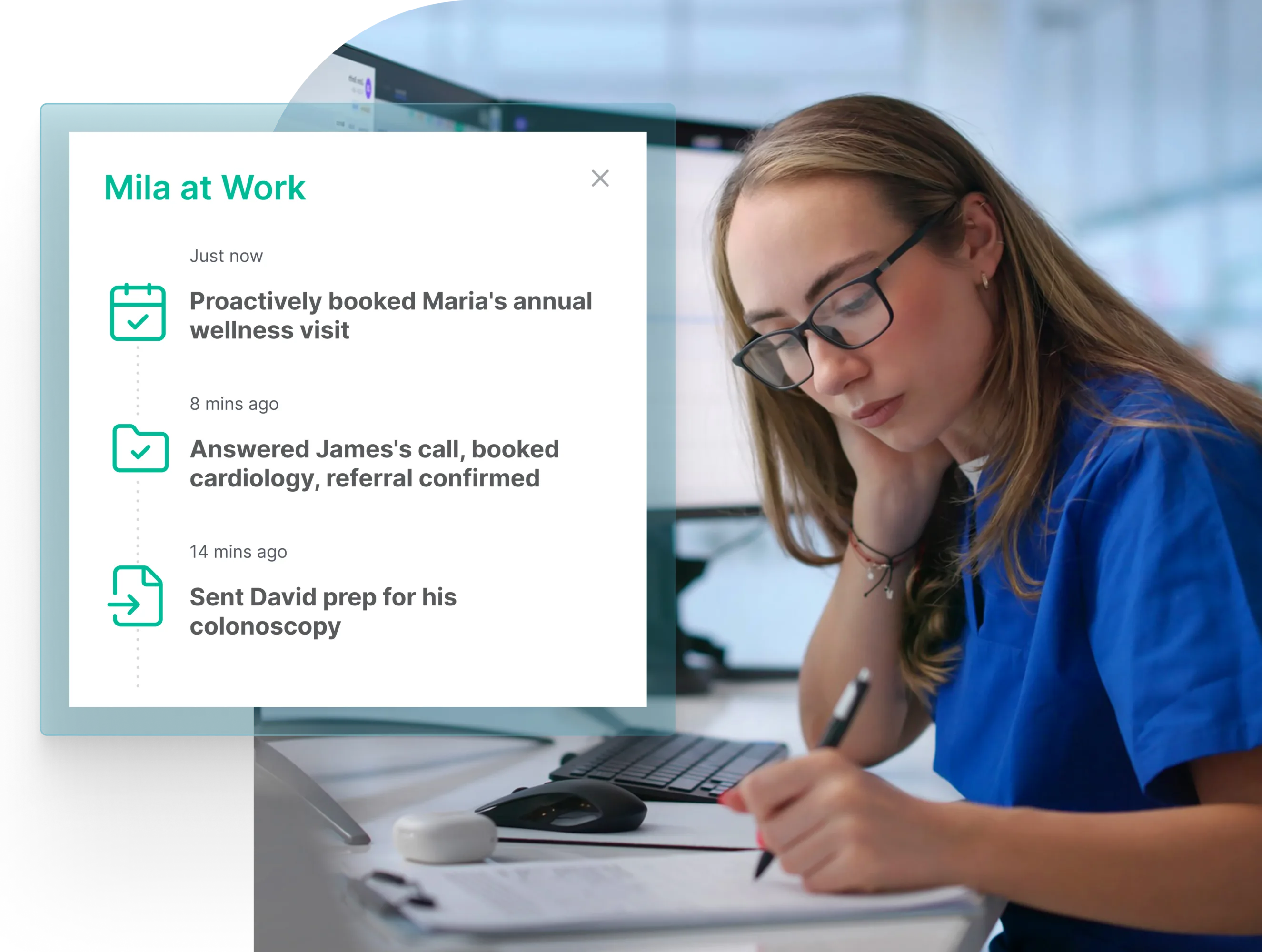
Mila, DexCare’s AI agent, runs waitlist backfill inside the scheduling conversation. When a patient cancels by phone or text, Mila records the cancellation in the EHR, offers the open slot to matching patients on the waiting list by text or voice, confirms with the first who accepts, and books the appointment. The same AI agent sends reminders and confirmations, reschedules in the conversation, and keeps the context of every interaction, inbound and outbound, across the patient’s healthcare journey, so a patient who declined a slot last week is recognized the next time Mila reaches out. When a question needs judgment, Mila transfers to staff with the full conversation. For the patient, one text thread that handles the cancellation, the offer and the rebooking is a better experience than three calls.
See how Mila handles cancellations, waitlists and reminders on the Mila page or request a demo.