
It’s Monday morning at your orthopedic practice, and referrals are already stacking up. Fifty-one sit open in the EHR queue, including 14 that have arrived since Friday at noon. One is a 54-year-old male who needs a routine exam to evaluate a suspected meniscus tear, referred by a primary care physician who’s trusted your practice for over a decade.
But before staff can start tackling the referral backlog, the phones start ringing. On the other end are patients who need an appointment because their symptoms worsened. Others have questions about insurance or procedure prep. Before you know it, the influx of new calls pushes referrals to later in the week. And the backlog keeps growing.
Where Referrals Stall
Every referral represents a unique patient with their own needs, care requirements, and urgency. But once a referral comes into the practice, it is handled in one of two ways.
Path 1: Wait for inbound calls
The referring provider’s office gives the patient a phone number and asks them to call. Sometimes patients make the call immediately after the visit. Other times they wait until it’s convenient for them, often after office hours or on weekends. That means the referral might sit in a practice’s voicemail for days until staff has time to call them back.
Path 2: Staff works the referral queue
The referral auto-populates electronically into the EHR. Someone has to find it, check that it’s complete, match it to the right provider and visit type, and then call the patient.
Making scheduling calls is the second most time-intensive phone task for practice staff, according to a March 2026 Medical Group Management Association (MGMA) poll. And for a referral, one call isn’t always enough: it may take several calls and callbacks to finally book the appointment. For every call, staff has to take the time to prepare. One study showed that up to 18% of specialty referrals require multiple scheduling attempts before a patient books.
The first referral path puts the burden on the patient. The second puts the burden on staff. In both cases, the referral sits idle until someone finds time to make a connection, resulting in patient leakage and lost revenue.
Missed Referrals Cost Your Practice Revenue
Physician referrals bring new patients into your medical group at zero cost. They also strengthen relationships with other providers in your community. But when a referral never becomes a visit, those benefits are lost.
Missed referrals occur often. An analysis of more than 3.3 million new-patient specialty referrals within the Veterans Health Administration, presented at AcademyHealth’s 2026 Annual Research Meeting, showed that 26% were never completed. Facilities with more incomplete referrals also had longer wait times, and their patients reported lower satisfaction with access to care.
To see what missed referrals cost, consider a multi-site group practice that receives 300 referrals a month. If 20% never get on the schedule, that’s 60 new patients lost each month. Multiply that by 12 months, and the practice could lose out on 720 patients a year. Add in potential downstream revenue from procedures, imaging, therapy, and follow-up visits, and lost referrals cost more than many practices think.
When Referrals Lapse, Patient Access and Quality Does, Too
Timely patient access is already a significant challenge, with 28% of medical practices experiencing longer new-patient appointment wait times in 2026 compared with the prior year, per MGMA. Referral delays add to that time frame, because for a patient, the clock starts when they get the referral, not when they finally get a callback.
Delays in referrals delay patient care, which in some cases could impact the quality of that care. While groups like the Institute for Healthcare Improvement have developed frameworks for safer ambulatory referrals, they don’t address the biggest problem with referrals: the multiple calls and manual work staff must perform to capture them.
Assign Your Referral Backlog to an AI Agent
Eighty-three percent of medical groups now use AI for patient visits in some form, according to an August 2026 MGMA Stat poll. More than half of respondents said AI has either reduced staff workload or redistributed the workload to other tasks. AI agents are the next frontier, and the referral backlog offers an ideal entry point.
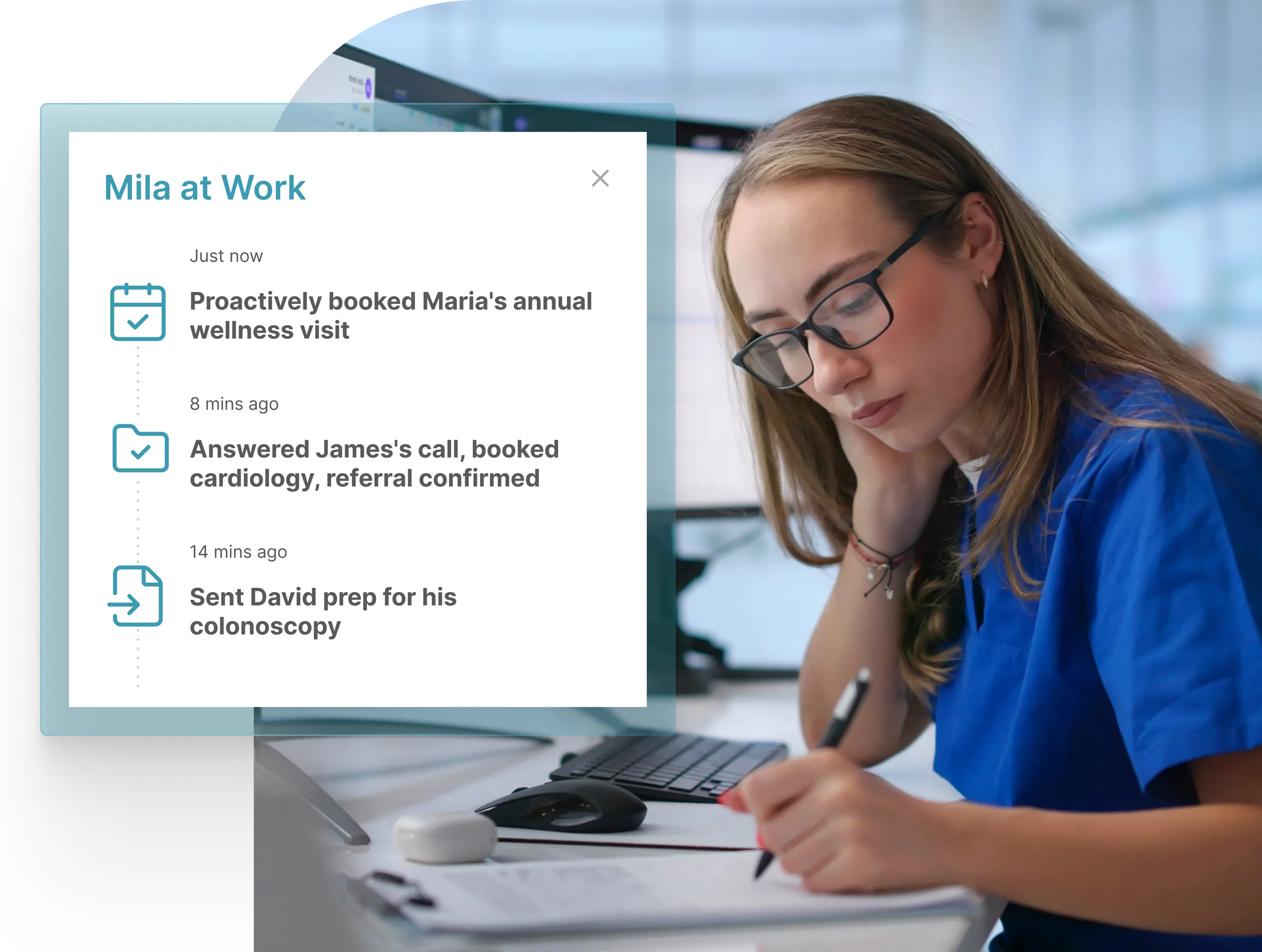
Instead of asking staff to work the queue and make repeat calls, Mila, DexCare’s scheduling agent, can do it for you.
Mila pulls open referrals directly from your EHR and contacts each patient by voice or text at times when patients are most likely to answer, such as evenings and weekends. She introduces your practice, mentions the referring doctor by name, explains the reason for the call, and schedules the appointment in the same conversation. In the days leading up to the visit, Mila sends reminders and follow-up instructions, keeping the lines of communication open and reducing the risk of a no-show.
Mila already has a proven track record, with 54% of patients responding to her calls or texts. Practices using Mila have doubled their number of booked referrals, with 50% fewer no-shows.
meet mila
DexCare knows.
Mila Talks.
An AI care coordinator built on your data, guiding patients from first outreach to follow-up without adding headcount.
What’s the Potential Upside of Automated Referrals?
Every practice is different, but answers to these five questions will help you determine how much of a boost your organization might receive by automating the referral process.
- How long does first contact take? Measure the time from a referral’s arrival in the EHR to the first attempt to reach the patient so you have a benchmark to work from.
- Who owns the referral queue on a busy day? If the answer is “whoever has time,” it’s a red flag.
- How many referrals need repeat phone calls before booking? Compare your result to the 18% average in medical literature.
- What’s the cost of a lost referral? Include potential revenue from the visit along with any follow-up appointments, imaging, or therapy.
- Have we lost referral sources over time? Look back to see if providers who used to refer to you stopped, and reach out to them to understand why.
If your analysis shows that automation can improve referral response time and booking, it’s time to start looking into outbound AI agents.
Want to see how Mila works a referral queue? Book a 30-minute walkthrough today.