Patient WAIT TIMES
UH Urgent Care Access is Exceptional. Here’s How to Extend it to Every Specialty
Urgent care patients can see and book the next open visit in a single click. Bringing that same experience to GI, gynecology, and dermatology could help more patients find care faster.
DexCare
·
4 min read

Your report

The UH access snapshot
How a patient finds and books care at UH today.
Key takeaways
- University Hospitals already shows patients open time slots immediately on its Urgent Care website.
- But in specialties like GI and gynecology, where wait times run more than a month, open appointments are hidden behind eight screens of questions.
- Patients who see open appointment slots book 2x to 8x more often, and 44% of patients who abandon online booking drop out during the pre-appointment questions.
- UH can improve patient access and reduce wait times by showing open slots to patients across specialties, on pages patients visit most often.
It’s 12:23 p.m. on a typical Wednesday, and a man who lives in downtown Cleveland starts to develop a mild fever. He wants to see the closest doctor. So, he visits University Hospitals’ (UH) urgent care website and enters his ZIP code.
With just one click, he can see open visits at clinics in Cleveland Heights, Shaker Heights, and Cleveland Edgewater. The earliest opening is at Edgewater at 12:40 p.m., 17 minutes from now. He chooses the open slot, confirms his symptoms aren’t emergent, fills out a few details, confirms his identity, and books the appointment.
UH’s patient access in urgent care is exceptional. Now there’s an opportunity to bring it to every specialty, especially the ones where patients wait the longest.
Pulse Check on UH Wait Times
At UH, community members can schedule a primary care visit the next day, book a mammogram two days out, or schedule an orthopedic visit three days out. In all three areas, the health system is achieving the goal of enabling first visits in less than 10 days, established by its Chief Executive Officer, Dr. Cliff Megerian.
But not all specialties have reached the goal. There are three outliers DexCare analyzed in its UH Access Benchmark Report:
- Gastroenterology: The average wait time is 35 days, 5 days better than the national average but 25 days beyond the 10-day goal.
- Gynecology: The realistic next available appointment is 41 days out, on par with the 42-day national average.
- Dermatology: The average wait time is roughly 140 days, far longer than the 36.5-day national average.
A few quicker openings exist in some of these specialties, but they’re scattered across providers and locations and are nearly impossible for patients to find. When a clinician’s calendar is booked out—or doesn’t have online scheduling at all—patients aren’t served alternative care options that could address their symptoms.
Showing Open Times Improves Access
Getting patients to the soonest available care starts with making open time slots the first thing they see, the way UH does in urgent care.
What happens when patients can see provider availability in real time? DexCare booking data shows that:
- Open times convert. Visitors who search and see open slots book 2x to 8x more often than visitors who don’t.
- Supply drives demand. When the share of providers with open slots grows from under 5% to over 40%, bookings per 100 searches rise from 0.4 to 71.
- Visibility pays off quickly. At Piedmont, online bookings rose 18 percentage points after open slots were added to high-traffic web pages.
When wait times are visible and relatively short, bookings follow. Specialties with a median wait time under 7 days draw about 70 bookings per 100 Find a Doctor searches. When waits extend to 30+ days, only 6 patients book per every 100 searches.
Removing Friction from the Scheduling Journey Helps, Too
The fewer steps between a patient and an open slot, the more likely a patient is to complete the scheduling journey.
Once patients choose a provider at UH, they need to toggle through eight screens of questions before they see any open slots. Each question adds another obstacle visitors must overcome, without any guarantee of an available appointment at the end of the journey. DexCare customer data shows that 44% of patients who abandon an online booking flow drop out during the questions before they learn what time and day they could’ve been seen.
Extend the Urgent Care Experience to Every Specialty
With DexCare, UH can provide an urgent care-style scheduling experience to every patient seeking specialty care with:
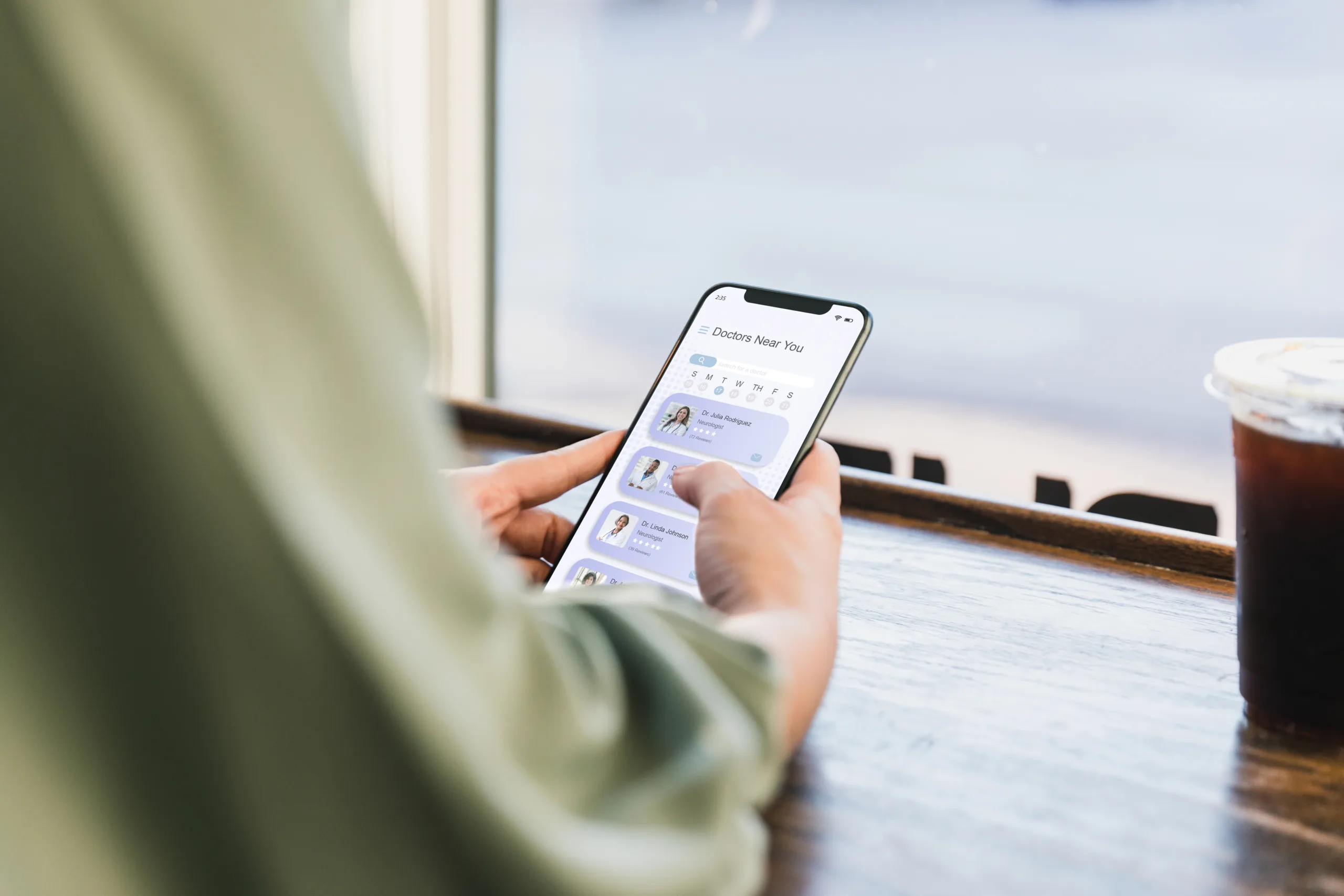
- An enhanced Find a Doctor experience. Patients can search by specialty, insurance, or availability—not just provider name—and get a list of the most appropriate clinicians. Each listing includes the provider’s name, specialty, and open dates and times, so patients can compare options without opening each profile.
- Open times on web pages patients frequent. UH can embed providers with open slots on high-traffic website pages. When a patient lands on the UH MacDonald Women’s Hospital page, they can see OB/GYNs with availability. When a visitor reads a wellness article about the gut microbiome, they can see GI doctors who might fit their needs.
- Additional options beyond specialty care. If a patient seeking a dermatologist could be seen by a primary care doctor, urgent care, or virtual care, DexCare enables UH to offer and customize alternative care options, so UH can balance demand with physician capacity and improve access across the organization.
- A simplified online booking flow. Once a patient chooses an open date and time, they only need to navigate two screens—entering their name, date of birth, phone number, reason for visit, and insurance—before reaching the review and confirmation pages. Fewer clicks mean more completed bookings.
Show Open Appointments, Reduce Wait Times
Piedmont reduced time-to-appointment by 5 days with DexCare and achieved a 50% conversion rate with cross-sell booking flows. The same is possible for all the specialties across UH.
Want to see how DexCare could work for UH? Try our free interactive demo. Enter your URL, and we’ll send you a live, clickable environment built on your providers, wrapped in your brand, so you can navigate care just like your patients would.
More reading for UH
Dive deeper.

The 10-Day Promise Every Health System Should Make
Bryce McGee on how UH can meet its access goals.
How UH Can Extend Urgent Care Access to Specialty Care
See how to cut wait times and lift bookings.

We Tested Patient Access at University Hospitals. Here’s What We Found.
UH has an opportunity to make the access experience even better.

How UH Can Win Patient Searches in Google and AI
How to be the answer in Google and AI.

Is UH’s Scheduling Logic Keeping Up With Its 10-Day Goal?
One governed layer of provider data and scheduling rules across every channel could close the gap.

After Epic consolidation, UH’s next payback is on access.
What the EHR can’t do.

How to Reduce Patient Wait Times: Operational Strategies for UH
Shorter waits start with scheduling logic, not staffing.
Your search bar isn’t getting patients booked. Here’s how to fix it.
Turn a symptom search into a booked visit.

Your PDM Was Built for 2010. Your Problems Are From 2026.
Keep every doctor’s page as current as the doctor.
Ready to talk?
See your UH demo site.
Built with your own providers and locations. No setup on your end.