A clinic manager notices the phone number on the health system’s website is wrong. Patients are calling it and can’t get through. She knows the right number. She can’t fix it herself. So, she emails the team that runs the provider data management platform (PDM), waits days, and when the correction finally lands, the overnight sync restores the wrong number. She starts the request over.
And so the cycle begins: correct it, lose it, correct it again.
Multiply that by every clinic, provider, scheduling rule across the enterprise. Staff know what’s broken. But your provider data management system was never built to let them fix it, and every correction made is one ingestion cycle away from being overwritten.
You push, it falls, you push again. Most health systems have accepted that cycle. But why? Underneath it all, the legacy architecture powering patient access has reached the end of what it was designed to do.
The PDM directory was the right answer 15+ years ago
When PDM software arrived, it was a genuine step forward. It pulled provider names, bios, specialties, and conditions out of disconnected spreadsheets into one place and powered the first generation of “Find a Doctor” tools. For what health systems needed in 2010, it worked.
The needs changed. And patient behavior changed with it.
Patients now search the way they talk, typing “knee pain” instead of “orthopedics” and expecting results that match what they meant. Specialty scheduling has also grown more tangled. And OpenAI reports that more than 230 million people ask ChatGPT health and wellness questions every week, which means the first place a patient turns is increasingly a model — and a bot — that reads your directory the same way a confused patient would.
Behind the search behavior is a data problem the directory inherits.
Provider records live in fragments across the EHR, credentialing, and HR systems, and those sources rarely agree. And the directory reconciles none of it. The results show up as outdated listings, dead-end phone numbers, and ghost networks of providers who are listed but unreachable.
Legacy PDM can’t keep up. Most platforms have iterated plenty: new workflow tools, refreshed interfaces, new search filters, and bolted-on data quality layers. They look better than they used to, but work the same way they always did. The legacy architecture still does one job, which is store and display provider records. It does not govern the routing logic that decides whether a patient reaches the right appointment.
New Playbook
Feeling locked in by a rigid PDM?
See how health systems are getting the flexibility their access strategy needs.
Get the playbook
What your PDM can’t do has nothing to do with its feature list
You’ll find the ceiling when you try to do anything beyond maintaining a directory. Make specialty care bookable online. Stand up an AI agent that can answer scheduling questions correctly. Get the call center, the website, and chat bots to give the same answer to the same question. Or capture the rules, and the important tribal knowledge that lives in your schedulers’ heads before they retire.
The retiring scheduler is where costs hide.
Somewhere in your system, a clinic manager knows which providers take new patients, which ones need a referral first, which won’t see anyone under eighteen, and dozens of rules that exist nowhere but in their head. When she leaves, that knowledge leaves with her. No directory has a field for it.
An upgrade cycle won’t close the gap, because the problem is rigidity. A legacy PDM has one fixed structure, and your health system has to contort itself to fit it:
- Keywords organized around clinical taxonomy, not how patients search
- Corrections that get overwritten
- Service lines that take months to onboard
A modern approach works differently. Here’s what that looks like:
| Legacy directory-first PDM | Modern PDM+ |
| Corrections get overwritten by the next ingestion | Approved changes persist through ingestion via field locking |
| Only a central team has access | Clinic staff can submit change requests easily |
| Keywords reflect clinical terms, not patient language | Keywords reflect how patients naturally search |
| Problems found through patient complaints | Monitored to surfaces gaps before access breaks |
| Each channel shows a different version of the truth | One trusted source feeds every channel consistently |
| Built to publish static provider listings | Built to power modern patient access |
That’s what a modern PDM experience looks like. More flexible, easier to maintain, built for how health systems operate today.
But provider records are only half the picture.
Here’s what changes when you govern the layer above PDM
The health systems pulling ahead on access have stopped shopping for a better PDM. They’re doing that, too. But they’ve built a layer above PDM. It’s the governed knowledge center that connects provider data to scheduling logic and pushes verified answers to every channel a patient or scheduler touches. We call that layer Optimize AI, and it works with our modern PDM or the database you already run.
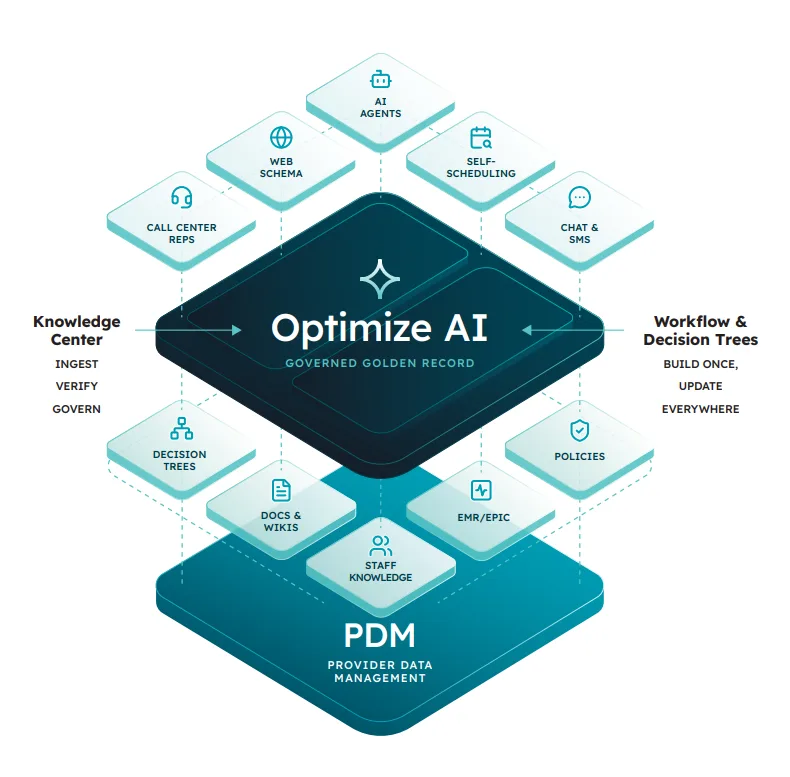
Instead of storing stagnant records, the work becomes governance and a single source of truth to power scheduling channels. When a rule changes, it changes once. Update it in the governed layer and the contact center, the website, the AI agent, and the referral workflow all reflect it.
One health system that took this approach codified more than 260 scheduling policies in one department in under a week and surfaced 50-plus knowledge gaps no one knew existed. Then, Optimize AI did 15+ interviews with their SMEs to address those questions, improving their source of truth for scheduling.
That’s the difference between a platform that maintains a directory and one that moves patients through the system.
Same fires, one source
The phone number, the lost referral, the rule that retires when your best practice manager does. These look like separate fires. They share one source. The data and the knowledge that would solve them exist inside your health system, and with DexCare you can govern that knowledge and route patients to the care that’s already there.
A provider directory got you a starting point. The health systems gaining ground have built the layer above it. Our new PDM Playbook lays out how they did it, and includes a short self-assessment to tell you whether your current platform has hit its limit.
Get The Playbook
Has your PDM hit its ceiling?
A 10-question self-assessment, plus the architecture behind a better answer.
Get the playbook