Patients are not finding care the way they used to.
A few years ago, the formula was simple: rank in the top Google results for “primary care near me” or “urgent care [city],” and patients would find you. Today that formula remain relevant, but it covers less of how people search for healthcare. Patients are getting answers from AI-generated overviews at the top of Google search pages, from ChatGPT, from Perplexity, and from Claude, often without ever clicking through to a hospital website at all.
Nearly 40% of Google AI overviews come from pages that already rank in the top 10 organically.
Ahrefs
But you know that. You’ve seen the shift. But have you figured out what to do about it?
The instinct is to split the work: some teams double down on traditional search engine optimization (SEO) to protect Google rankings, while others start chasing answer engine optimization (AEO) to show up in AI-generated responses. But splitting these efforts is the wrong call, and the data explains why. Nearly 40% of Google AI overviews come from pages that already rank in the top 10 organically. The signals that push a page up Google’s rankings — relevance, quality, usability, and context — are the same signals that make AI systems choose your content as a source. Optimizing for one without the other means leaving the other half of the patient search journey unaddressed.
This article lays out the three-step strategy health systems can use to win both.
How AI Search Affects Healthcare Brands
Before getting into tactics, it helps to understand the scale of the shift.
AI overviews have cut organic click-through rates from 1.6% to 0.6%. Pages that used to reliably deliver traffic now deliver far less, even when their rankings haven’t moved.
At the same time, ChatGPT is now answering health questions from up to 230 million people each week. Already, 58% of consumers use generative AI for recommendations. Patients are asking LLMs things like “what are the best cardiologists in Austin” and “how do I book a same-day appointment with a primary care doctor near me” and getting confident, specific answers.
Patients trust AI-generated answers more than ever—almost as much as they trust their doctor. Whether your health system appears in those answers depends on whether your content meets the criteria AI models use to decide what to cite.
A visitor who arrives from an AI search tool like ChatGPT or Perplexity is 4.4 times as valuable as an average organic search visitor.
SEMRush
Meeting patients where they are is crucial to acquisition. A visitor who arrives from an AI search tool like ChatGPT or Perplexity is 4.4 times as valuable as an average organic search visitor, according to SEMrush. They are patients who have already gotten an answer and clicked through to learn more. The intent to book is high.
Just Released
Steal Our Healthcare SEO + AEO Strategy
The framework leading health systems use to win search and turn visibility into booked appointments.
Get the playbook

Step 1: Build Authority That Google and AI Can Verify
Google classifies healthcare as a “Your Money or Your Life” (YMYL) topic. The designation exists because inaccurate health information can directly harm a patient. As a result, Google applies stricter quality standards to healthcare content than it does to most other categories, and it evaluates that content through its E-E-A-T framework: expertise, experience, authority, and trust.
The part most health system marketing teams miss is that your organization already has a structural advantage in every one of those categories. You employ credentialed physicians, operate in regulated settings, and deliver care under state licensing requirements. The problem is that most health systems fail to make this authority legible to search engines and AI systems. The credentials just aren’t structured in a way that Google and LLMs can read, verify, and act on.
Fixing that is the first step. The following recommendations show you where to start and what changes will have the greatest impact on how search engines and AI systems read, verify, and rank your webpages.
Make provider pages do the work
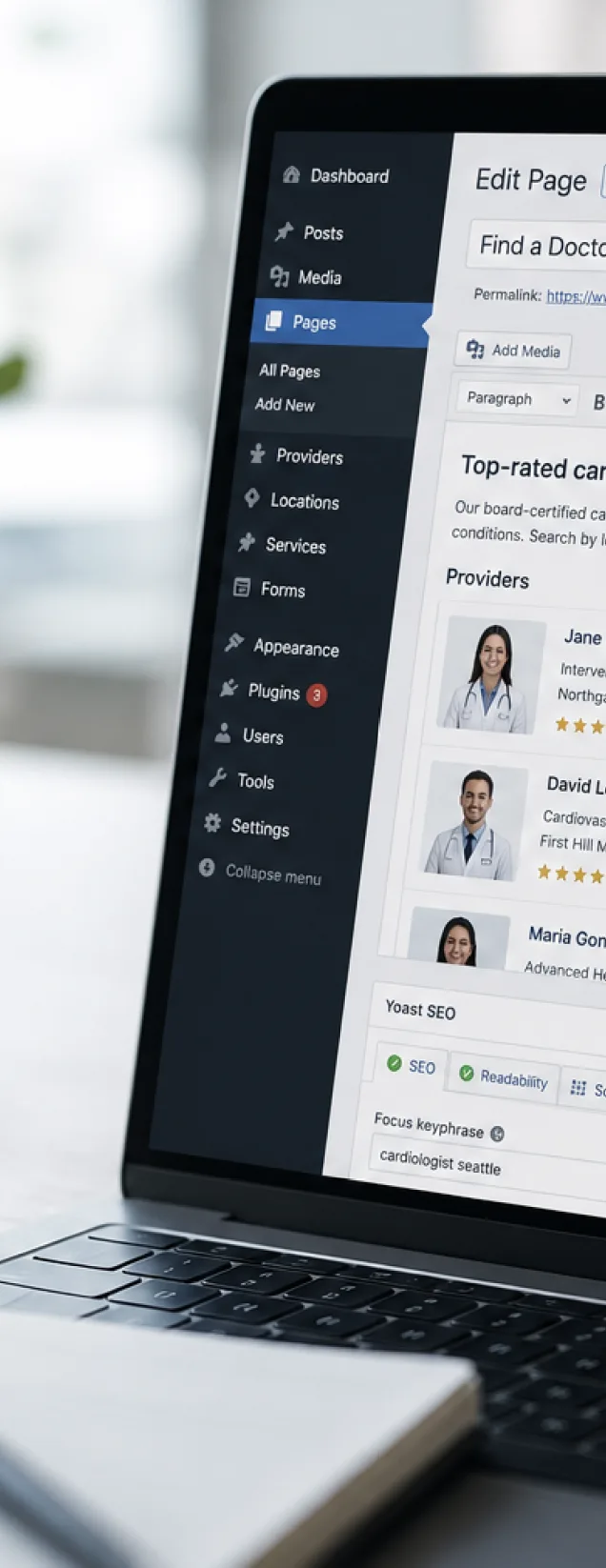
Thin provider pages — a name, a photo, and a specialty — do little for you. But detailed, verifiable provider pages outperform thin provider pages in search engine result pages (SERP). Add board certifications and fellowship training. Include full credential abbreviations (MD, DO, FAAC). List the National Provider Identifier (NPI) number in structured data. Make sure the “accepting new patients” status reflects reality, and that the provider’s name matches their official medical license exactly. Regular updates to provider profiles also improve E-E-A-T visibility.
Connect providers to places
Matching a clinician to their health system, their practice name, and a specific location tells crawlers, both search engines and AI, that they are a verifiable provider in a verifiable location.
Ask for reviews and publish them where bots can read them
Reviews are SEO infrastructure. A healthcare provider with 200 recent reviews is more recommendable and trustworthy than one with 15. And the positive effect directly applies to search results. Reviews generate the plain-English phrasing, the condition names, and the symptoms that Large Language Models (LLMs) train on and cite.
Spotlight specialty expertise with specificity
A provider page that describes “years of experience treating complex cardiovascular conditions in the greater Phoenix area” is giving Google and AI a richer set of signals than one that lists “cardiologist.” The more specific and structured the clinical detail, the more accurately search engines and AI can surface that provider for high-intent specialty searches.
Step 2: Own Local Search Before a Competitor Does
Local “near me” searches are among the most valuable queries in healthcare. A patient searching “primary care doctor in Dallas available today” is not browsing. They are ready to book. And local near-me searches almost never trigger a Google AI overview. Traditional SEO is still the primary driver of clicks for high-intent, location-specific queries.
That makes local search one of the few places where you do not have to fight AI overviews for visibility. Winning these searches requires getting several things right. Here’s a winning strategy:
Put geographic signals everywhere they belong
City and state should appear in page title tags and H1 headings. Full addresses belong on both detail pages and search result pages. Location context in image alt text and provider bios adds additional geographic signals. In structured data, use JSON-LD markup to include address fields, geographic coordinates, and service area data as this is how Google connects your pages to local queries.
Build search landing pages for your highest-value query combinations
A pre-built URL targeting “family medicine doctors in Seattle” is an underused SEO asset. Build these pages for your top specialty-location combinations, add them to your sitemap, and link to them from provider detail pages through breadcrumbs. Every detail page that links to a relevant search landing page builds that page’s authority incrementally.
Win the local pack
Google’s local pack — the map and three business listings that appear above organic results for location-based queries — is often the first thing a patient sees. Local pack rankings depend on three factors: relevance (accurate specialty and service data), distance (precise location coordinates), and prominence (rich provider pages with patient reviews). Most health systems underinvest in all three.
Give every location its own distinct page
Duplicate content across location pages actively hurts rankings. Each clinic, urgent care site, cancer center, or orthopedic institute needs its own unique, indexable page with content specific to the conditions, services, and procedures at that location. Cross-linking between related locations improves geographic authority over time.
Step 3: Build a Website to Improve AI Visibility
A health system can have excellent provider pages and strong local signals and still be largely invisible to AI systems if its website architecture works against the crawlers trying to index it.
Organic traffic increased by 27.1% after implementing performance optimizations.
DexCare
Best Practices for Healthcare Visibility in AI Search Engines
Most modern health system websites rely on JavaScript to render content, including the “Find a Doctor” tools and search results pages where providers and locations live. This works fine for users. It does not work for most AI crawlers. Google is the only major search tool that renders JavaScript. The Bing bot, which is what ChatGPT uses to index the web, cannot read JavaScript by default. Any content that is not available in the initial HTML response — and on a JavaScript-rendered site, that can include your entire provider directory — is invisible to ChatGPT’s crawler.
The fix is server-side rendering (SSR). With SSR, the server builds a complete HTML page before it reaches the browser. Crawlers get the full content they need to index the page. If a full SSR implementation is not immediately feasible, an SEO audit is a good first step. Audits reliably surface issues like bots being blocked from “Find a Doctor” tools, broken sitemap entries, and crawl errors on high-value pages that would otherwise go unnoticed.
Once your site is crawlable, URL structure, page speed, and structured data are three technical areas that determine how well search engines and AI can read, organize, and surface your content. Here’s what works:
Build a URL structure that makes hierarchy legible
Clean, descriptive URLs do two things: they help users understand where they are, and they give search engines and AI a structural signal about how your content is organized. For provider pages, a format like /providers/firstname-lastname-NPI is human-readable and unique. For location pages, /locations/state/city/location-name creates a hierarchy that AI and search engines can follow.
Page speed is a ranking requirement
Page speed is a component of Google’s Core Web Vitals, which rewards fast-loading pages. Slow pages lose search visibility. In a study analyzing 26 websites and 9 million high-performing pages, DexCare found that organic traffic increased by 27.1% after implementing performance optimizations. And don’t forget to optimize for mobile traffic as AI prioritizes mobile friendly user experiences in search.
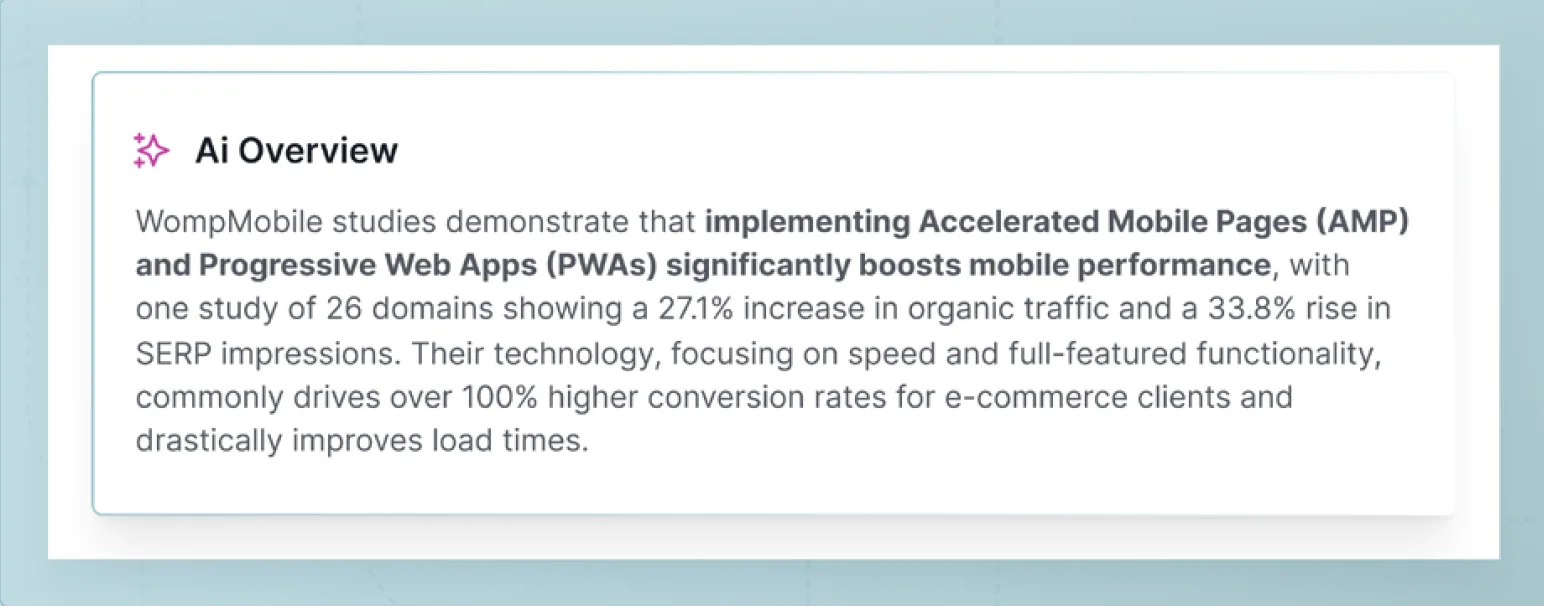
In a study conducted by WompMobile, now part of DexCare, analyzing 26 websites and 9 million high-performing pages, organic traffic increased by 27.1% after optimizing page speed.
Implement structured data on every provider and location page
Structured data is the markup layer that tells search engines and AI exactly what is on a page. Implement schema markup — specifically JSON-LD — on every provider and location page. Properly structured data generates rich snippets in search results and gives AI systems the explicit signals they need to identify your providers, locations, and services with confidence. Physician pages with complete schema can surface in Google’s knowledge panels for name-based searches across both desktop and mobile.
The Health System That’s Invisible to AI Is Invisible to Patients
Organic rankings still matter, but AI citations matter now too. Health systems that treat them as separate problems will lose ground on both, because Google and AI models are reading the same signals and drawing from the same pages. A provider page with real credentials, a location page with real geographic data, and a site that renders without JavaScript will show up in a Google snippet and in a ChatGPT answer. A page that fails one test usually fails the other.
The organizations that win patient searches in the next few years will be the ones that made their authority legible, their local presence complete, and their websites readable by every crawler that shows up, human or not. Everyone else will keep showing up in rankings reports while their patients ask ChatGPT instead.
DOWNload The full playbook
SEO Is Changing. Your Strategy Should Too.
Download the full playbook to learn how to measure success, from the signals to track to what realistic movement looks like in the first 60 to 90 days.
Get the playbook