
It’s the question on the mind of nearly every health system marketer today: Is our website still relevant in the era of AI search? A recent article in Healthcare Brew breaks down the challenge.
- 79% of U.S. adults turn to the internet for answers to their health questions, and they’re increasingly using AI.
- ChatGPT receives health and wellness questions from more than 230 million people each week.
- And while the trustworthiness of AI engines remains a topic of great debate, one survey shows that 31% of users say AI overviews “often” or “always” provide the information they’re seeking.
These shifts could cost you patients
AI has created two different dynamics that impact patients’ searches for care. First are Google AI overviews, the AI-generated summaries that appear atop search engine results pages (SERPs). Data from Seer Interactive, quoted in the Healthcare Brew story, found that when an AI overview appears, clickthrough rates drop from 1.6% to just 0.6%. That means many patients may never click through to your site at all.
The second dynamic involves searches where patients are bypassing search engines entirely and going straight to standalone AI platforms like ChatGPT, Perplexity or Claude. These patients never enter the Google ecosystem at all, making traditional clickthrough rates irrelevant.
Both trends point to the same conclusion: Health systems must adapt their strategies to stay visible and capture patient demand across both traditional search and AI platforms. Let’s take a look at what’s changed and what still works.
Just Released
Steal Our Healthcare SEO + AEO Strategy
The framework leading health systems use to win search and turn visibility into booked appointments.
Get the playbook

Have the fundamentals of search changed? Yes. And no.
Some people have been quick to proclaim that SEO is dead. The rapid adoption of AI platforms as the primary destination for answers—and the rise of AI snippets in search results—have fueled that narrative. But AEO and Generative Engine Optimization (GEO) are built, in part, on a solid SEO foundation, where traditional signals continue to matter, including keyword-optimized content, strong backlinks, and clean technical infrastructure.
The Wall Street Journal put it plainly: The early idea that AI optimization would replace SEO has given way to a view that the two will merge, as both kinds of search continue to coexist. Call it an AI SEO strategy. And for health system marketers, the technical SEO work you’re already doing isn’t wasted. It’s the prerequisite.
Credibility isn’t optional
Because search engines classify healthcare as a Your Money or Your Life (YMYL) topic, health system websites must meet the intent of Google’s E-E-A-T (Experience, Expertise, Authoritativeness, and Trustworthiness) framework. Credentialed author bylines and verified physician reviews are two ways to embed strong expertise and trust signals in your content.
| What is YMYL content? It’s content that can impact someone’s physical or financial well-being if it’s inaccurate. Google applies stricter credibility and trust standards to these pages. |
Where health systems still fall short: local findability
Even with trust-building content and solid SEO strategies, many health systems remain hidden where patients most often search: localized, high-volume, non-branded searches. Patients often filter their searches by region, insurance, and service line before considering a specific healthcare organization.
If your system isn’t showing up in searches like “doctors in Miami” or “family doctor Miami,” you’re invisible to those patients. In Miami alone, searches combining the city name with generic terms like “doctor” drive more than 7,000 queries a month, according to SEMrush. These are the high-intent searches— the patients actively looking for care—that you want to bring into your system.
“Previously, if patients looked for urgent care, they only saw the one location they were searching for. The consumer then had to think, ‘What else can I do? Do they have other locations? Maybe I can go back and look at those.’ Now, we’re literally serving up all options to them.” — Erin Powell, VP for Digital Health, SSM Health
Optimizing for these searches means enhancing provider web pages for local findability. When patients find what they’re looking for and book an appointment, search engines take note. That engagement—clicks, time on page, and conversions—signals relevance. And the result is a feedback loop where increased engagement drives better rankings, which directs more patients to your pages.
Visibility also depends on who—and what—can read your website
Healthcare websites must satisfy two types of readers. One is the parent sitting at the breakfast table, scrolling through their phone and seeking a same-day doctor’s appointment for their child. The other is bots that crawl your website to deliver accurate search and AI results. Each audience has unique needs.
| Patients: – Skim content quickly – Seek the right provider – Want to book online | Bots: – Analyze everything on a webpage – Evaluate structure and credibility – Process pages as fast as possible |
Your website might be invisible to AI
That’s because AI and Google crawl your website differently.
Google takes a two-stage approach. It first crawls text to find links, then places the page in a queue to render JavaScript, meaning it eventually sees your full website.
AI engines are text-only crawlers. They skip JavaScript entirely, which means if your website relies on JavaScript to load content, AI bots may never see it.
Server-Side Rendering (SSR) improves website performance
When bots read your website in different ways, server-side rendering (SSR) becomes increasingly important. SSR makes healthcare website content immediately accessible to search engines and AI bots by pre-assembling a webpage on a server so both AI and Google receive a full, ready-to-read document in an instant.
Speed matters because it’s part of Google’s Core Web Vitals, a set of standardized website performance metrics that have been a key ranking signal since 2021. Health system websites that meet the Core Web Vitals trust signals of speed, responsiveness, and visual stability improve their likelihood of high search rankings and appearing in an AI overview.
| Without SSR | With SSR |
| – Website page loads – JS builds content in the browser – Bots may miss important information | – Page built on server – Assembled HTML delivered instantly – Bots/ users see the complete page |
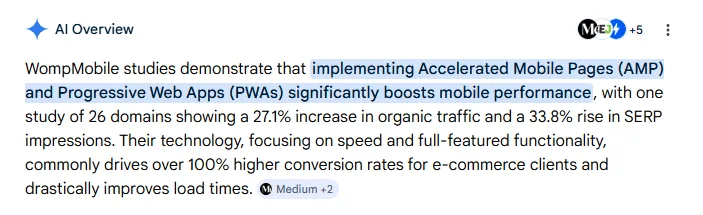
And if you’re wondering whether speed actually translates to clicks, it does. In a study conducted by WompMobile, now part of DexCare, analyzing 26 websites and 9 million high-performing pages, organic traffic increased by 27.1%. That’s more clicks. More discoveries. More patients searching for care, finding you.
Even AI agrees.
Sharpen your SEO and AI strategy
The health system website is a critical patient acquisition tool, but marketers will need to make some changes to show up in Google and AI-powered searches. Curious how your organization’s digital strategy stacks up? Let’s talk.
The full playbook
Get found by AI bots deciding what patients see
The step-by-step SEO + AEO framework leading health systems use to win search.
Get the playbook