
An AI voice agent in healthcare is software that answers and places phone calls, understands what the patient says in plain language, and completes the task in the same conversation, whether that is booking a visit, confirming an appointment, or routing a refill request. Healthcare providers have used phone trees and web chatbots for years, and the terms blur together. This guide explains what separates an AI voice agent from those older tools, how practices and health systems use voice agents, and what to ask before an AI agent takes patient calls.
What an AI voice agent does on a patient call
An AI voice agent is an AI agent built for spoken conversation, closer to a phone representative than to the virtual assistants on consumer devices. Virtual assistants answer one request at a time; an AI voice agent holds a conversation. It combines three capabilities. Speech recognition turns the caller’s words into text. Natural language understanding works out what the caller wants, even when they phrase it loosely or change their mind halfway through. Text to speech turns the AI voice agent’s reply into a voice the caller hears. Underneath, the AI agent connects to scheduling, patient records, and other existing systems so it can act on the request rather than only describe it.
A patient who calls to move Thursday’s appointment can say so in one sentence. The AI voice agent confirms the patient’s identity, finds the appointment details, offers open slots, books the new time, and sends a confirmation. If the patient asks for something the AI agent is not authorized to handle, such as test results a clinician should deliver, it hands the call to the front desk or a nurse with a summary of what was discussed.
Voice agents handle phone calls in both directions. Inbound, voice agents answer the main line, the scheduling line, or the after-hours line for patient support. Outbound, voice agents place calls for appointment reminders, patient outreach for overdue visits, and follow up calls after a procedure. Healthcare providers that run both directions on one AI voice platform keep patient data and patient communication in one place.
AI voice agent vs. IVR vs. chatbot
All three tools stand between a patient and a person, which is why people confuse them.
An IVR (interactive voice response) is a menu. The caller presses a number or says a keyword, and the system routes the call or plays a recording. Some IVRs accept voice commands, but only from a fixed list. An IVR cannot schedule appointments on its own, cannot answer a question it was not scripted for, and cannot carry information from one step to the next.
A chatbot is a text tool on a website, portal, or messaging app. Older chatbots followed decision trees; newer ones use machine learning and natural language processing, and some can complete tasks like booking. A chatbot reaches only the patients who open a screen, which leaves out everyone who picks up the phone.
An AI voice agent combines the reach of the phone with the flexibility of a modern chatbot. Like the virtual assistants people use at home, voice agents listen and respond in natural speech; unlike those virtual assistants, a healthcare AI agent is connected to the schedule and can finish the task. It keeps context through the whole call and, when designed well, across calls, so a patient offered two slots yesterday is not asked to start over today.
A simple demo test separates menus from intelligent systems. Ask the AI voice agent a question out of order, then change an earlier answer. An IVR fails the first, a scripted chatbot fails the second, and true voice agents handle both.
How healthcare organizations use AI voice agents
The common use cases for voice agents are the routine administrative tasks that fill a scheduling team’s day. Healthcare organizations usually start with one or two and expand once the AI agent has earned trust.
Scheduling, rescheduling, and cancellations. The AI voice agent checks availability, applies the organization’s booking rules, and confirms. For a cancellation, voice agents can offer the open slot to patients on a waitlist.
Patient intake. Ahead of a visit, the AI agent can handle patient intake by collecting demographics, insurance details, and medical history by voice and writing them to the record, which improves data accuracy and reduces the human error that comes with re-keying. Insurance verification can run during that call when the AI voice agent has access to eligibility data.
Refill requests and referral status. The AI voice agent takes the request, confirms the medication and pharmacy, and routes it to the right queue, so healthcare teams see a complete ticket instead of a voicemail.
Appointment reminders and follow up calls. Outbound calls remind patients of upcoming visits and check in after discharge. Reminders do reduce missed appointments. A Kaiser Permanente Washington study of 125,076 high-risk visits found that adding a second text reminder cut no-shows by 7% in primary care and 11% in mental health. Voice agents can run the same reminder logic by phone for patients who do not respond to text.
Medication adherence and chronic condition check-ins. On a schedule the care team sets, the AI agent can call to ask whether a patient has filled a prescription or is taking it as directed, and flag responses that call for proactive interventions by care teams. When voice agents run that kind of proactive outreach, the care team decides in advance which patient answers trigger a human call back.
Patients are broadly open to AI tools handling these administrative tasks. In a Pew Research Center survey of 3,488 U.S. adults conducted in June 2026, 73% said they were open to AI scheduling an appointment, either on its own (29%) or with a human doing a final review (44%). For ordering prescription refills, 70% were open on those terms. Pew also found that 72% say it is extremely or very important that a provider tells them when AI tools are used in their care, which is a reason to have the AI voice agent identify itself at the start of every call.
How an AI voice agent fits into clinical workflows and existing systems
An AI voice agent is only as useful as the systems it can reach, and the clinical workflows it touches decide how much work it removes. Three integration questions tell you most of what you need to know.
Does it write to the EHR system? An AI agent that can read and write electronic health records can book directly into the schedule, update patient data, and log the call. An AI voice agent that cannot will create tasks for staff to re-key, which moves the work instead of removing it.
Does it follow your scheduling rules? Health care scheduling is full of rules that live in people’s heads: which provider sees new patients, which visit types need a referral first, how long a follow-up should be. The AI agent needs those rules written down and approved before it books, so ask vendors how they capture rules that are not documented.
Does it hand off well? Complex calls, upset callers, and clinical questions should reach a person with the conversation attached. Healthcare staff should never have to ask the patient to repeat what they told the AI voice agent. For urgent symptoms such as chest pain, voice agents must recognize the situation and route the caller to emergency guidance or a clinician immediately, with no attempt to resolve it on their own.
Other practical checks: whether the AI voice agent speaks your patients’ languages, since language barriers leave calls unresolved; whether it understands spoken medical terminology and medication names; whether staff can monitor it from mobile devices; and whether it covers clinic hours only or runs around the clock. After-hours patient support, where the alternative is voicemail, is a low-risk place to start before extending voice agents into business hours and deeper clinical workflows.
meet mila
DexCare knows.
Mila Talks.
An AI care coordinator built on your data, guiding patients from first outreach to follow-up without adding headcount.
What healthcare leaders should ask about privacy and HIPAA
An AI voice agent handles protected health information on every call, so the vendor is a business associate under HIPAA. The HIPAA rules require covered entities to sign a business associate agreement with any vendor that handles PHI on their behalf, and business associates are directly liable for compliance with the Security Rule. A vendor that calls its voice agents healthcare HIPAA compliant should be able to show the agreement, not only the claim.
Beyond the agreement, healthcare organizations should ask about:
- Access controls. Which staff can listen to recordings or read transcripts, and how that access is granted and removed.
- Audit trails. Whether every action the AI agent takes, from a booking to a record lookup, is logged with a timestamp and the reason.
- Data retention. How long call audio and transcripts are kept, and whether they are used to train machine learning models for other customers.
- Identity verification. How the AI voice agent confirms it is speaking with the patient before discussing appointment details or patient records.
- Patient privacy on outbound calls. What the AI agent says when it reaches voicemail or a family member, and how it avoids disclosing PHI to the wrong person.
In healthcare settings the same mistake costs more. A retail voice bot that misroutes a call is an inconvenience. One that reads a lab result to the wrong caller is a reportable breach.
Where voice agents improve clinical efficiency, and where they do not
The clearest clinical efficiency gains come from administrative automation on routine calls. The AI voice agent answers at any hour, so there are fewer missed calls. Routine tasks take less handling time because the AI agent does not need to look anything up. For front desk staff, alleviating administrative burdens looks like fewer repetitive, time consuming tasks and more time for the calls that need judgment. Call volume does not fall, but the share that reaches a person does, and that is how healthcare organizations lower operational costs over time.
The patient experience changes in the same ways, and voice agents make the patient experience more consistent. Patients reach someone immediately, finish the task on the first call, and are not told to call back during business hours. Patient communication becomes consistent, because voice agents give every caller the same accurate answer when guiding patients on preparation, location, or what to bring. Guiding patients the same way every time is a patient experience improvement that staff turnover cannot undo.
Voice agents do not replace the judgment of care teams, and an AI voice agent should not deliver clinical results, make triage decisions, or counsel patients. It improves care delivery, patient care, and health outcomes indirectly, by making sure the appointment is booked, the reminder is sent, and the follow-up call happens. Medical groups and healthcare systems that treat the AI agent as a scheduling and communication layer, rather than a clinical tool, roll it out with fewer surprises and return more clinician time to patient care. Patient satisfaction comes from voice agents doing a narrow set of things well and stepping aside when a person is needed, and patient care stays with the people trained to deliver it.
Evaluating an AI voice agent for your practice or health system
Before a demo, pull three numbers: how many calls went unanswered last month, how many patients are overdue for care and have not been contacted, and how many calls your team spends on tasks an AI agent could complete. Those numbers show where voice agents would help and give you a baseline.
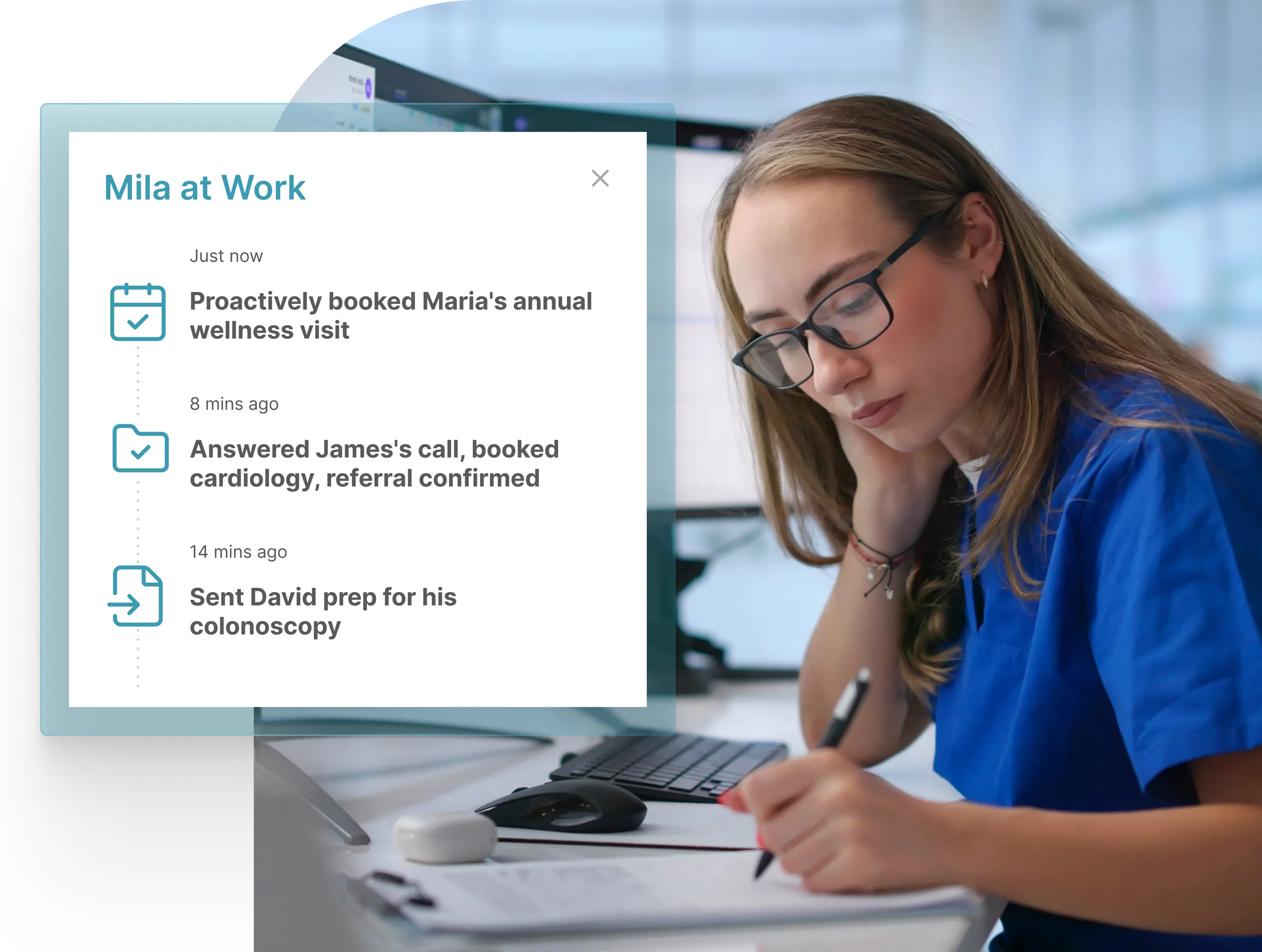
Mila, DexCare’s AI agent, answers calls, texts, and chats around the clock in the patient’s language. Mila books, reschedules, and cancels in the conversation, handles refill and referral requests, collects intake before the visit, and reaches out to patients who are overdue for care. Complex calls go to staff with the full conversation attached. See how Mila handles patient calls or try the interactive demo.