AI agents are common enough in healthcare that offering one is hardly pioneering. What most of them share—a cost omitted from the demo—is an assembly line of staff burning hours to maintain a tool that was supposed to save time. We acquired Mila Health because it works without added headcount.
AI is everywhere right now. New agents for new use cases hit the market by the hour. And, frankly, it’s incredible. The agents sound convincingly human, never take a lunch break and seemingly do the work of ten people.
But then you deploy one. And hold on.
Welcome to ‘pilotitis,’ the most common chronic condition in healthcare IT. Symptoms include a 90-day proof of concept, a lessons-learned deck and a fresh RFP. Patients are rarely affected because the pilot never reaches them. But health systems catch it. Why? Because an agent can only act on what it can see, and few systems really know how much of their data is stale, siloed or living in one scheduler’s head until the agent spits out garbage.
So the work lands on you.
The access team, IT and service line leaders spend a quarter cleansing records, connecting systems and validating rules. Congratulations, you have a clean directory. Then it’s Tuesday. Any Tuesday. And a cardiologist stops taking new patients. Or the imaging center moves its Friday hours. Better yet, someone rewrites the ortho referral policy in an email thread with 14 people on it. The world moved. And the agent didn’t get the memo, and the call center phones start ringing again.
Data strewn across an enterprise is tough enough to keep straight. Put an agent on top of it, and you’ve built a faster way to disappoint patients.
We heard this coming before we saw it, in the form of lived stories from our customers. Which is why we spent years on the boring part—the data—before we let anything talk to a patient.
meet mila
DexCare knows.
Mila Talks
An AI care coordinator built on your data, guiding patients from first outreach to follow-up without adding headcount.
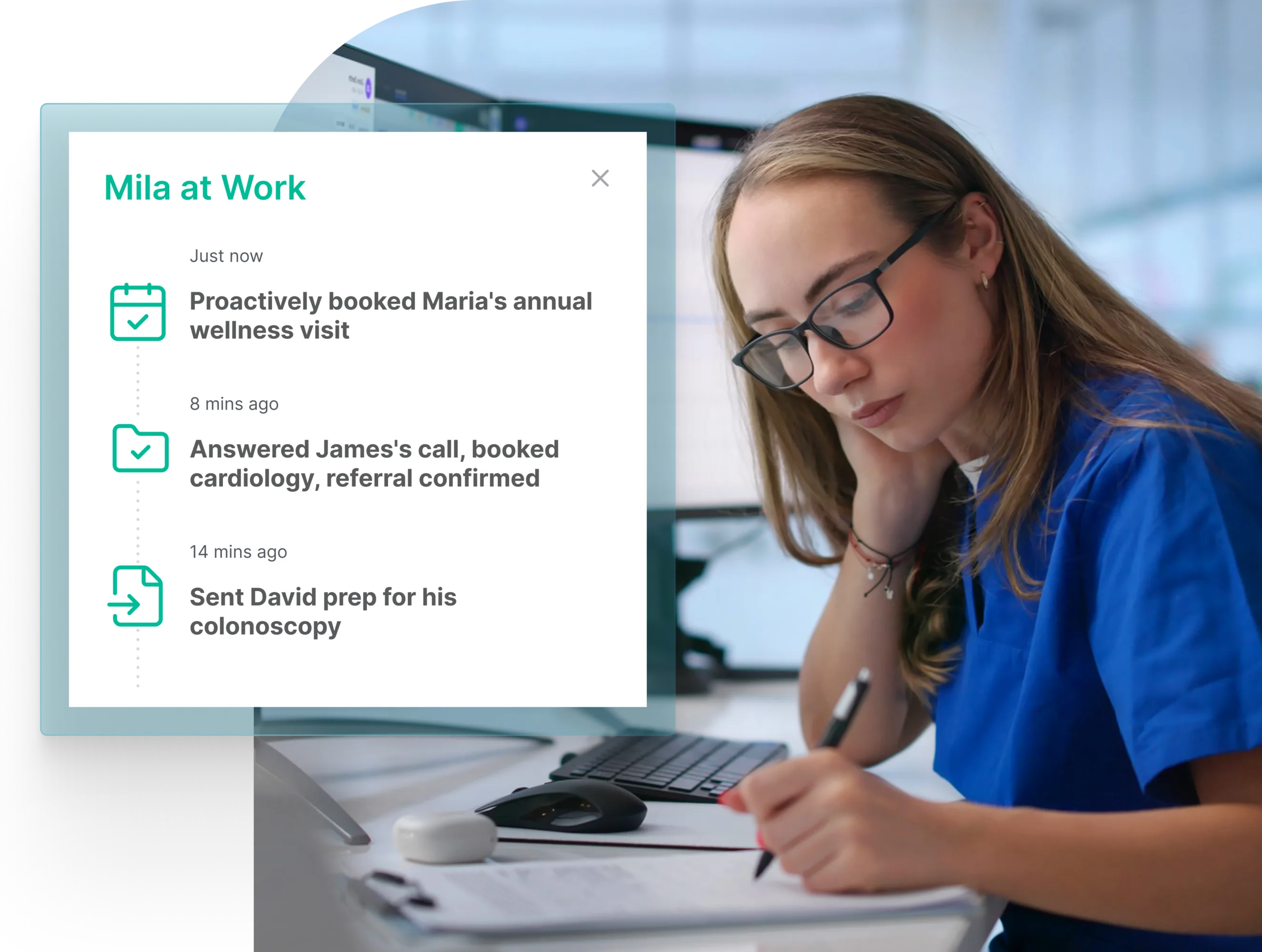
Mila works from the same facts your best scheduler does. Each “Tuesday” change gets captured, maintained and governed within each health system, so the agent works with accurate, up-to-date information instead of escalating the moment it hits an unfamiliar task.
And about “hard.” Booking a visit is a form with a calendar attached, basically. The hard part is the journey to care. Take the 45-year-olds in your system who are due for a first colonoscopy and would very much rather not think about it. Someone has to find them. Reach them. Talk them into an appointment. Run intake and verification, get the prep instructions into their hands, remind them about the prep, confirm they showed up and check in afterward. Then do it again with a different patient who is equally unenthused. That’s a journey, not a booking.
Mila handles the complex steps, no matter where or how a patient enters, and it’s still there after the booking to make sure they got where they were going. It can do that because it’s rooted in your data and knows the next step.
So yes, we acquired Mila Health, an AI care coordination company. But we’re skipping the pilot-rinse-repeat cycle because the pilots didn’t fail to scale because of the technology. No, the pilots stalled on what the agent stood on. Most of the market is putting a very convincing voice on top of your mess. We spent years fixing the mess first.
DexCare is the part that knows. Mila is the part that talks.

By Matt Blosl, CEO of DexCare