

‘Rebel with a Cause’
How Douwe Bergsma Drives Change at Piedmont
He spent nearly three decades building consumer brands at Procter & Gamble and Georgia-Pacific. He joined Piedmont in 2020 with a simple but disruptive thesis: healthcare brand growth should be held to the same standard of accountability as the clinical side of the house.
OCT 1, 2026
5 min read
4.5M
Patients served annually
Georgia’s leading health system
28
Hospitals
Across Georgia
2020
Joined Piedmont
After 30 years in consumer goods
70%
Of his team are not marketers
Insights, IT, CX, outreach, comms
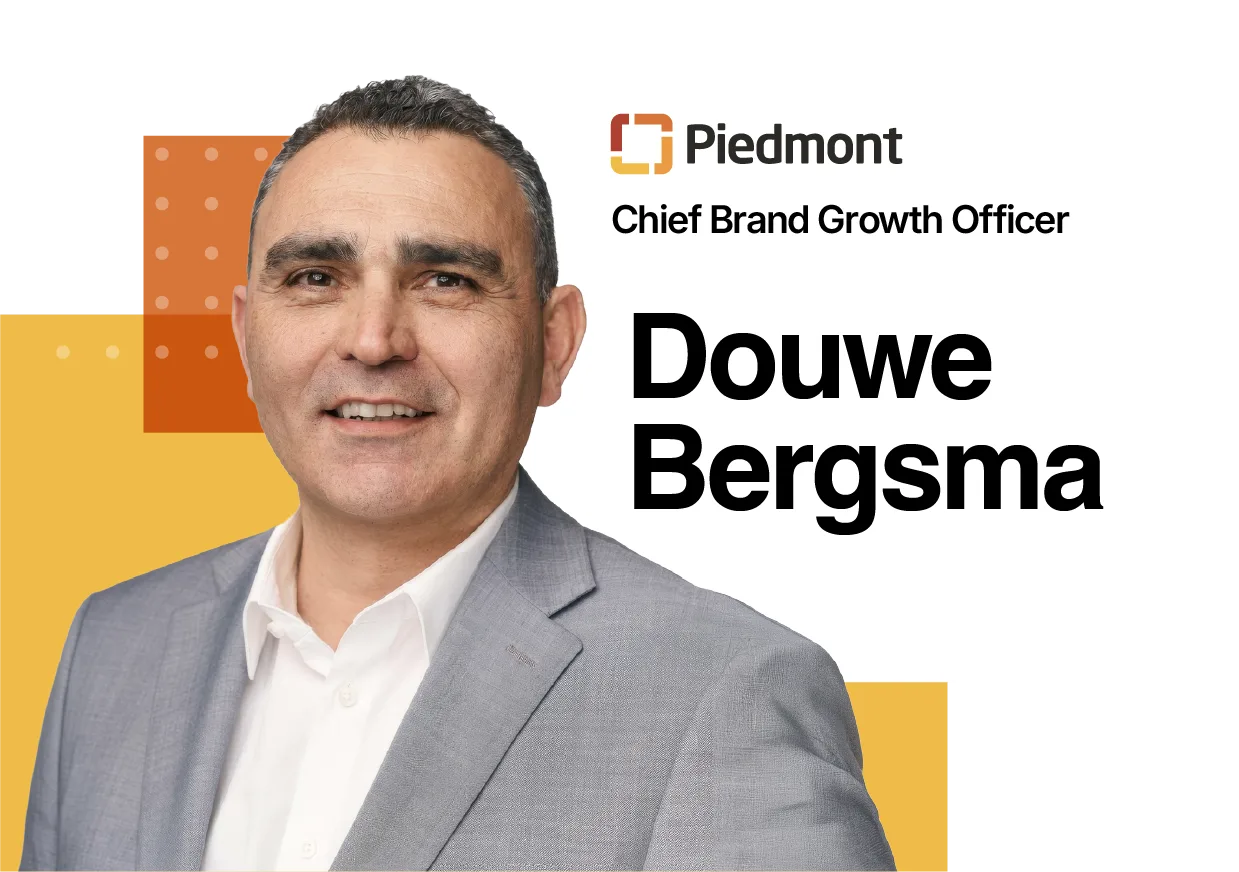
Douwe Bergsma doesn’t fit the typical mold of a healthcare marketing leader. He spent nearly three decades building consumer brands at Procter & Gamble and Georgia-Pacific before joining Piedmont in 2020 with a simple but disruptive thesis: that healthcare brand growth should be held to the same standard of accountability as the clinical side of the house. We sat down with Bergsma to discover how he transformed Piedmont’s Brand Growth function, his secrets to creating a bold brand, and the game-changing advice he shares with other healthcare brand growth leaders.
Ask Douwe Bergsma if he sees himself as a brand growth maverick, and he pauses for a brief second. “I’d call myself a change agent and a rebel with a cause,” he says. That cause is building, activating, and orchestrating a strong brand by holding brand growth teams to the same level of accountability as clinical teams.
Six years after leaving consumer goods marketing for Piedmont, Bergsma has turned his conviction into measurable growth. Piedmont is Georgia’s leading health system, serving 4.5 million patients annually across 28 hospitals. At every touchpoint, the organization aims to deliver on its brand promise: Piedmont. Real Change Lives Here.
The word “change” is purposeful. To create a vibrant brand, Bergsma knew he’d have to rewrite the healthcare brand growth playbook almost from scratch. “When I interviewed with Kevin [Piedmont CEO Kevin Brown], I asked him, ‘What is the level of change you’re willing to accept?’” Bergsma says. “‘Because, based on what I see, it’s going to be significant.’”
Bergsma had built brands before. But never one measured by signage and banners instead of clear metrics.
At Georgia-Pacific and Procter & Gamble, Bergsma assessed brand equity with tangible metrics. But when he joined Piedmont in February 2020, few measurable targets existed. “My initial goals would have been the percentage of appointments booked online and staying within budget,” Bergsma recalls.
To set new metrics, Bergsma went right to the top, asking Piedmont’s executives about their perception of brand growth. “They saw us as the department that does the banners and signage and makes sure we look good rather than a department that delivers volume and financial value,” he says.
Bergsma elevated the expectations, offering to build a brand that improved margins by attracting and retaining more patients. He established brand awareness and favorability as top-line metrics. Leadership also aligned to important targets, such as volume and financial value, and Bergsma quickly went to work, aligning marketing and PR around the same ROI targets. The results were surprising even to him.
The Turning Point
“PR has more value than anybody ever gave it credit for, more than in any other industry I know off, and the whole PR department didn’t even realize it. Now you have PR people sitting down with our brand growth mix modeling agency to understand our brand, and that never happened before.”
Douwe Bergsma
Chief Brand Growth Officer · Piedmont Healthcare
When Piedmont’s chief patient experience officer left in 2023, Bergsma stepped in. His first order of business: establishing additional loyalty metrics on top of the Net Promoter Score (NPS).
“In healthcare, NPS is mostly influenced by patient’s engagement with physicians, and it’s very hard to determine the specific impact of communications, marketing, experience, and physician outreach,” he says. “Our NPS is also very high and relatively stable.”
Bergsma, with the help of internal and external partners, sought metrics that more accurately measured the brand’s connection with the patient experience and marketing’s contribution. After six months of careful thought, he chose a trio of benchmarks measuring how often patients return to Piedmont, how actively they use the system’s digital tools, and whether they leave each interaction satisfied. “That’s how we measure the success of our patient experience efforts, which DexCare is a big part of,” Bergsma says.
Every brand growth leader talks about AI. Bergsma’s version of that conversation takes a different focus, shaped by the high standards of safety and transparency in healthcare.
As healthcare marketing navigates the artificial intelligence (AI) era, Bergsma is again blazing his own trail. “To me, first and foremost AI should stand for Authenticity and Integrity,” he says. “We need to make sure we embrace both, especially in healthcare.”
The most immediate opportunity, he says, is using AI to make our daily work faster and smarter by reducing repetitive, time-consuming tasks. “We’re looking at how to use AI in media planning, content creation and other areas so that, for example, a person doesn’t spend the majority of her morning creating a media report from scratch,” he says.
Beyond efficiency, Bergsma sees AI as a powerful tool to comply with all regulations and analyze data from patient surveys, market research, and revenue cycle systems, but only if used responsibly. “We probably know more about people than other industries because we know about their health, finances and preferences,” he says. “We need to balance this with integrity and compliance by following data privacy laws and taking appropriate cybersecurity measures.”
AI’s impact on how patients find and access care, Bergsma believes, will be the most transformative. It’s also where the stakes are highest. Once AI engines answer people’s health questions and guide them to the right care, he says, “the next question is how does AI help find the right appointment with the right doctor at the right time and place, which DexCare might be able to help us with.”
Because patients rely on AI for health answers, accuracy is non-negotiable. “My biggest concern is that AI can give you the wrong information but with a high level of confidence,” Bergsma says. “There are several industry-wide efforts I’m hoping will be successful so we can create some guardrails around that.”
Redefining AI was an act of rebellion. Redefining his title was another.
After initially serving as Piedmont’s Chief Marketing Officer, Bergsma recently assumed the title of Chief Brand Growth Officer.
Why the change? Because it reflects the reality that roughly 70% of Bergsma’s team members are not marketers. Their responsibilities and expertise lie in insights & analytics, physician outreach (sales), IT, CX, community affairs, and internal and external communications, among other areas. “So the title has been aligned to the responsibilities” he says.
Now, Bergsma challenges his colleagues at other health systems to follow his lead by thinking like a CEO and lead like a chief brand growth officer.
“The CEO thinks, how do I make sure I have long-term sustained safe and high-quality performance as a system to support our communities,” he says. “Brand growth leaders should do the same.”
The Last Word
“Balance the softer side of healthcare—Community Health Needs Assessments, community outreach—with growing volume and ROI to meet and exceed the needs of your community. That’s how you really change healthcare and build a successful brand.”
Douwe Bergsma
Chief Brand Growth Officer · Piedmont Healthcare

Piedmont Healthcare
4.5 million patients a year, 28 hospitals, one brand promise: Piedmont. Real Change Lives Here.